The Complete Guide to Using a Yoga Timer
A yoga timer is one of the most underrated tools in any practitioner's toolkit. Whether you are just beginning your yoga journey or have practiced for decades, timing your sessions properly removes one of the biggest obstacles to a deep, focused practice: constantly checking the clock. Every time you glance at your phone to see how long you have been holding a warrior pose or a yin hip opener, you break the mental stillness that yoga is designed to cultivate. A dedicated yoga countdown timer eliminates that distraction entirely.
Why Yin Yoga Specifically Needs a Timer
Yin yoga is a slow, floor-based style that targets deep connective tissue — the fascia, ligaments, and joint capsules — rather than the muscles worked in more active styles. Because yin poses require long holds, typically three to five minutes each, a yin yoga timer is an absolute necessity rather than a luxury. Holding a dragon pose or sleeping swan for four minutes while mentally counting seconds is both stressful and inaccurate. A bell chime at the end of each interval tells your body to release and transition without any mental effort from you. This is the single feature that sets a proper yoga interval timer apart from a basic stopwatch.
How to Set Up Your Yoga Practice Timer
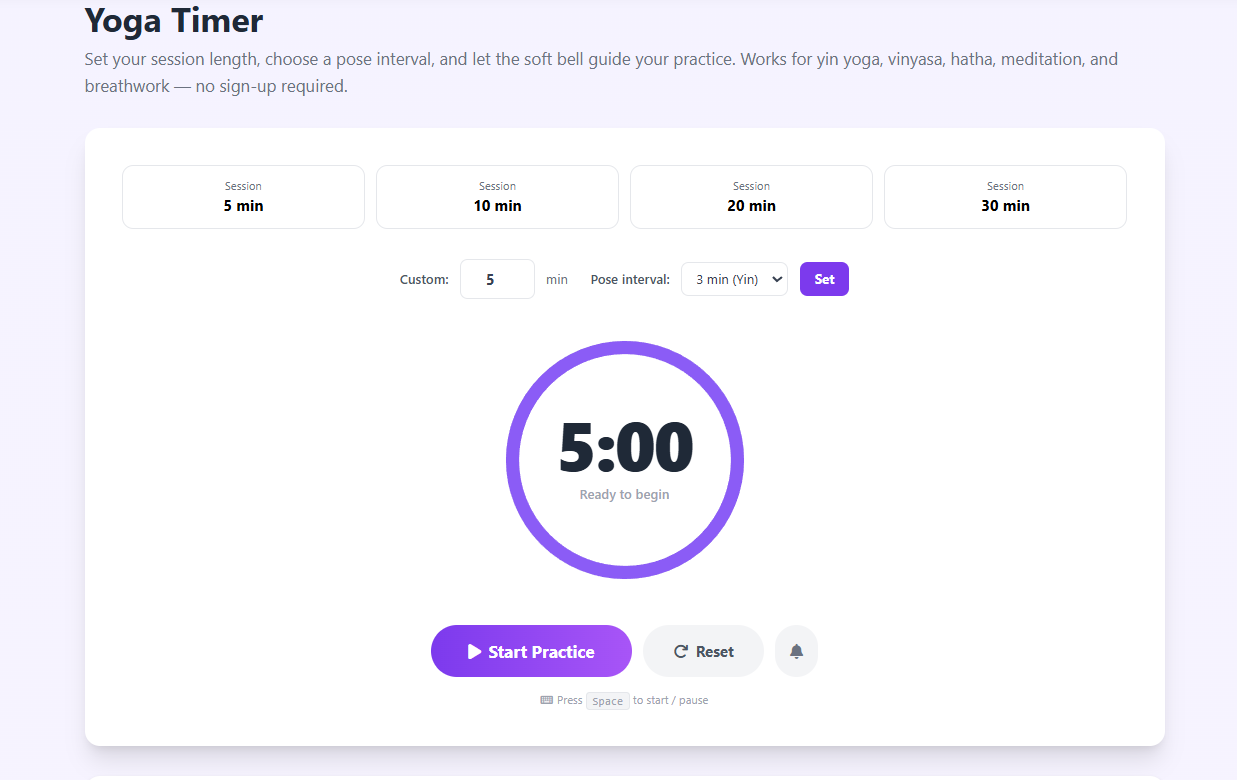
Setting up this online yoga timer takes under thirty seconds. Choose your total session length — five minutes for a quick morning stretch, twenty to thirty minutes for a standard home practice, or sixty to ninety minutes for a full yin class. Then select your pose interval from the dropdown: one to two minutes for vinyasa flows, three to five minutes for yin holds, or no interval for pure sitting meditation. Press Start, place your device where you can see or hear it, and begin. The ring animation shows your session progress at a glance, and the soft bell sound cues every transition without jolting you out of a relaxed state.
Yoga Timer for Meditation and Breathwork
Beyond asana practice, this yoga meditation timer is equally effective for pranayama and seated meditation. Set a twenty or thirty-minute session with no interval for an uninterrupted sit, and the single end-of-session bell closes your practice gracefully. For structured breathwork such as box breathing, alternate nostril breathing, or the Wim Hof method, use the interval feature to mark each breathing phase. Many practitioners pair this timer with our Study Timer for focused reading of yoga philosophy texts or anatomy books between sessions.
Teaching Yoga Classes with a Timer
Yoga teachers and studio instructors can use this online yoga clock to structure their class pacing without interrupting the verbal flow of instructions. Set the interval to match your planned pose duration, and let the bell handle the transition cues while you focus on observation, adjustment, and student support. For classroom-style teaching environments where a visible countdown is needed, our Classroom Timer complements this yoga timer perfectly. Teachers who run back-to-back classes also find our Pomodoro Timer helpful for managing prep time and recovery periods between sessions.
The Science of Timed Yoga Practice
Research on connective tissue physiology shows that fascia responds most effectively to sustained, gentle stress held for a minimum of ninety seconds. For yin yoga specifically, most practitioners and anatomy researchers recommend holds of three to five minutes to allow the fascia and joint capsules to fully release and remodel over time. Without a reliable yoga pose timer, most students underestimate how long they have been in a pose and release far too early, missing the deep therapeutic benefits. Consistent timed practice over weeks and months produces measurable improvements in range of motion, reduced chronic tension, and improved joint health that shorter, untimed holds simply cannot replicate.
Building a Daily Yoga Practice with Timers
The most common reason yoga practitioners fail to maintain a consistent daily practice is not lack of motivation — it is uncertainty about how long to practice and when to stop. A clear session timer solves this problem immediately. Setting a ten or fifteen-minute yoga timer each morning creates a defined, non-negotiable practice window that feels achievable even on your busiest days. As your practice deepens, you simply increase the session duration. The Sleep Timer on this site pairs naturally with evening yoga nidra or restorative practices, while the 5 Minute Timer is ideal for quick breathwork or desk yoga breaks during the workday.
Yoga at Home vs. Studio: Why the Timer Matters More at Home
In a studio, the teacher manages all timing for you. At home, you are entirely responsible for your own pacing, which can lead to cutting poses short, losing track of time, or simply feeling uncertain throughout the session. A dedicated yoga interval timer creates the structure of a guided class in your own space. It signals beginnings and endings clearly, builds a reliable practice rhythm, and replaces the habit of phone-checking that breaks concentration and, frankly, makes you more likely to stop early. Whether you practice on a mat in your living room, at a park, or in a hotel room, this browser-based yoga timer works on any device, anywhere, completely free.