The Ultimate Guide to Workout Timer Training
A workout timer is arguably the most versatile piece of equipment in any fitness arsenal. Whether you are pushing through a high-intensity interval training session in your living room, running a structured circuit at the gym, grinding through a Tabata protocol on an exercise bike, or timing rest periods between heavy barbell sets, an interval timer automates the timekeeping so you can direct your complete physical and mental energy toward the work itself. Every second you spend watching a clock is a second you are not spending on form, intensity, and performance — and that trade-off compounds significantly across a full workout.
HIIT Training: The Science of Work-to-Rest Ratios
High-intensity interval training derives its extraordinary effectiveness from the specific manipulation of work-to-rest ratios. When you alternate between periods of maximum or near-maximum effort and structured rest, you push your body into oxygen debt — a state where your aerobic system cannot fully meet the energy demands of the exercise. This creates what exercise scientists call excess post-exercise oxygen consumption (EPOC), colloquially known as the "afterburn effect," which elevates your metabolic rate for anywhere from 14 to 48 hours after the workout ends. The practical result is that a 20-minute HIIT session performed with a proper workout interval timer can burn significantly more total calories over 24 hours than a 45-minute steady-state cardio session at moderate intensity.
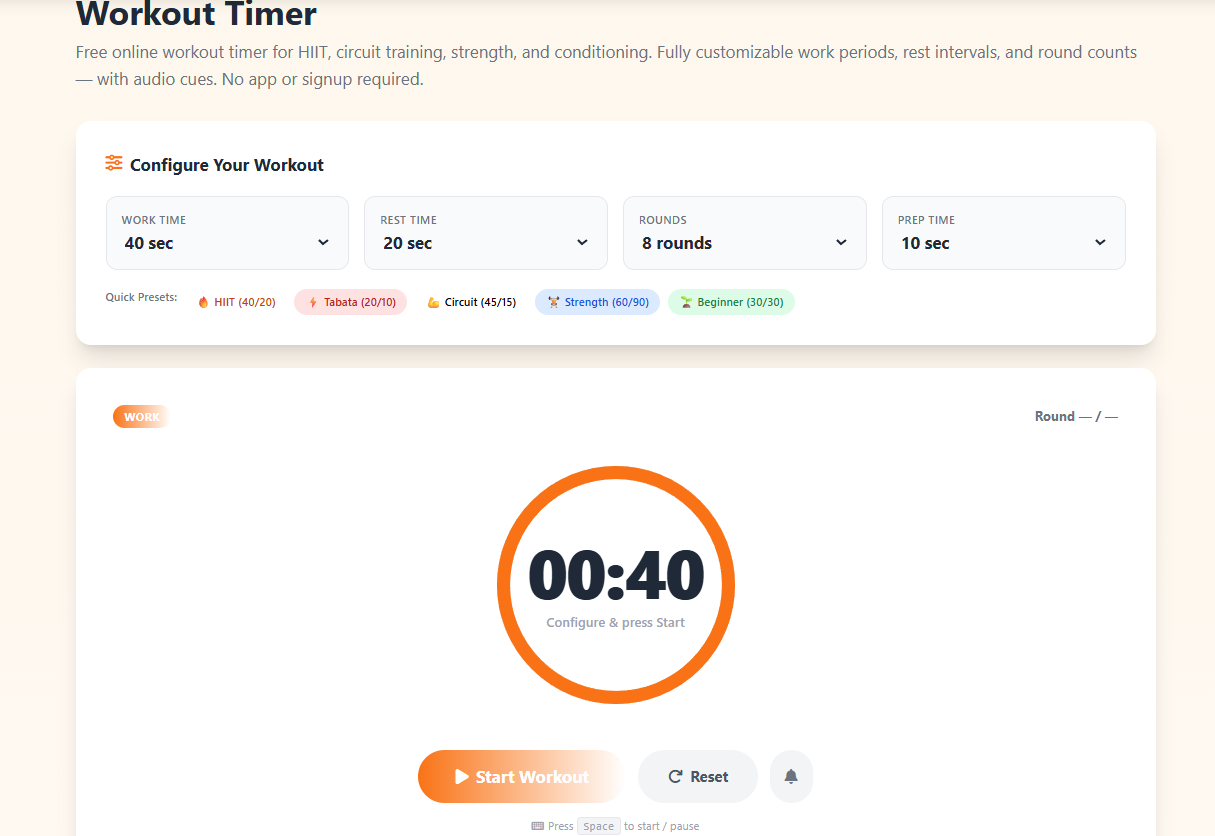
Our free workout timer gives you complete control over the work-to-rest ratio that determines the character of your training. A 40-seconds-work, 20-seconds-rest ratio (2:1) is the classic HIIT format that maximizes caloric expenditure and cardiovascular stress. The Tabata protocol uses an extreme 2:1 ratio with very short intervals — 20 seconds on and 10 seconds off — for 8 rounds per exercise. A 1:1 ratio (30 seconds work, 30 seconds rest) is accessible for beginners or for exercises requiring significant skill and coordination. Strength-focused sessions benefit from extended rest periods of 60–90 seconds to allow phosphocreatine system recovery for maximum force production in each working set.
Circuit Training with an Exercise Timer
Circuit training — moving through a sequence of exercises with minimal rest between stations — is one of the most time-efficient training methodologies available. A well-designed circuit can simultaneously develop strength, muscular endurance, and cardiovascular fitness in a single session. The exercise interval timer is the essential tool that makes circuit training work, defining exactly how long you work at each station and precisely when you transition to the next. Without structured timing, people naturally slow down during challenging exercises, extend rest periods unconsciously, and lose the metabolic intensity that makes circuit training effective.
For a balanced bodyweight circuit, set work intervals to 45 seconds with 15 seconds of transition time. Choose 6–8 exercises targeting different movement patterns: push (push-ups), pull (inverted rows or band pulls), squat (bodyweight squats or jump squats), hinge (Romanian deadlifts or good mornings), carry (farmer carries or suitcase carries), and core (planks, mountain climbers, or hollow holds). Run 3–4 complete circuits with 2 minutes of rest between each full circuit. The combination of our workout timer for the circuit format and our dedicated Plank Timer for targeted core holds gives you everything you need for a complete training session.
Using a Workout Timer for Strength and Conditioning
Strength training is typically programmed in sets and reps rather than timed intervals, but a workout timer adds a powerful dimension of structure to traditional lifting sessions. Timed rest periods prevent the common tendency to extend recovery beyond what the training objective requires. For hypertrophy (muscle growth), research supports rest periods of 60–90 seconds between sets — enough recovery to sustain high mechanical tension across multiple sets, but short enough to maintain metabolic stress and growth hormone elevation. For maximum strength development, rest periods of 2–5 minutes allow more complete neural and phosphocreatine system recovery, supporting heavier loads in subsequent sets.
The workout timer's round counter works perfectly for strength training set tracking — each "round" represents one working set, and the rest interval between rounds enforces consistent recovery time. Set work time to 60 seconds for a typical working set (representing time under tension plus transition), set rest to 90 seconds for hypertrophy or 120–180 seconds for strength, and set total rounds to match your programmed set count. The timer handles the structure while you focus entirely on executing each set with maximum quality. For complementary combat sport conditioning, combine your gym sessions with our Boxing Timer for structured heavy bag rounds.
Home Workout Timer: No Equipment, No Excuses
The modern fitness revolution has demonstrated conclusively that the gym is optional — the most effective workouts require nothing more than a body, a floor, and a reliable interval timer. A bodyweight HIIT circuit using push-ups, burpees, mountain climbers, jump squats, and plank variations can produce cardiovascular and muscular adaptations equivalent to machine-based gym workouts when performed with sufficient intensity and structure. The key word is structure — and that is precisely what this free workout timer provides. Load the timer on your phone, place it on the floor next to your mat, and let the audio cues drive your training without any additional equipment investment.
Recovery, Rest Days, and the Workout Timer
Training adaptation does not happen during the workout itself — it happens during recovery. This is why rest periods within workouts are not optional, and why rest days between intense sessions are as important as the training itself. Use the workout timer to enforce structured intra-workout recovery rather than resting "until you feel ready," which almost always extends beyond what training science recommends. Between training days, use our Sleep Timer to ensure you get the 7–9 hours of restorative sleep that exercise performance research consistently identifies as the single most important recovery intervention available.
Programming Your Workout Week with Timer Protocols
Effective weekly programming requires variety in both exercise selection and energy system demands. A well-structured training week might include two HIIT sessions with the 40/20 protocol, two strength-focused sessions with 60-second sets and 90-second rest, and one moderate-intensity circuit day using the 45/15 format. This variety prevents adaptation plateaus, reduces overuse injury risk, and keeps motivation high by providing different physical challenges throughout the week. For dedicated study or deep work sessions between your training days, the Pomodoro Timer applies the same interval discipline to intellectual work that this workout timer applies to physical training — helping you stay sharp and productive during recovery days.