What Is a Tomato Timer and Why Does It Work?
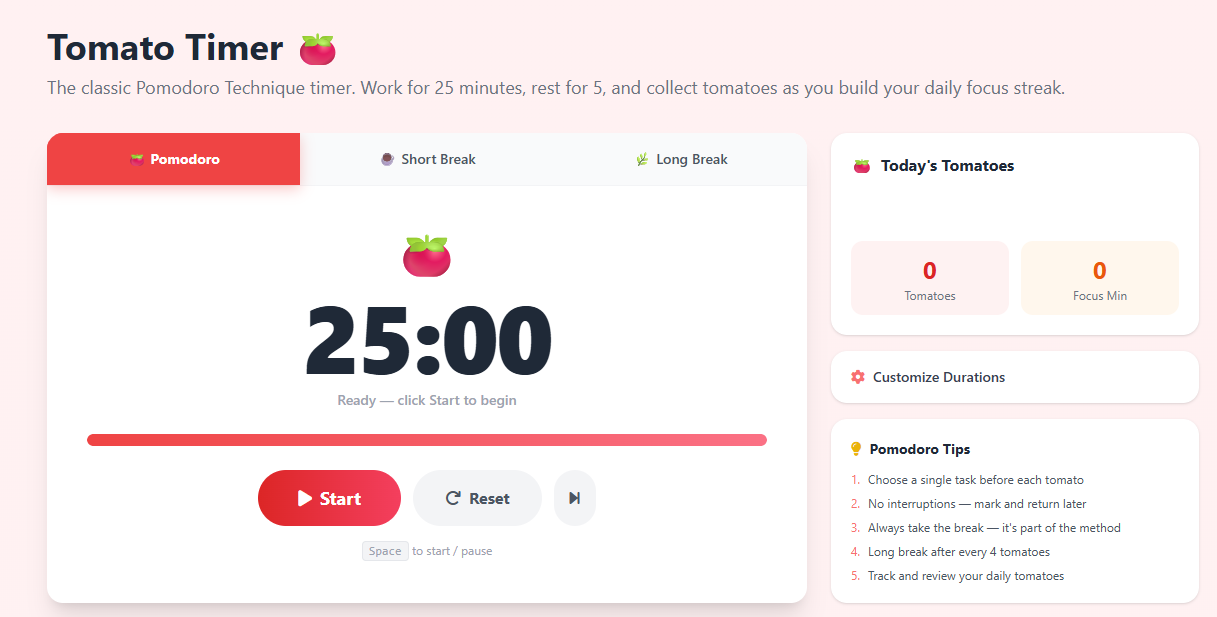
A tomato timer — also known as a Pomodoro timer — is a time management tool built around the Pomodoro Technique created by Francesco Cirillo in the 1980s. The name comes from the tomato-shaped kitchen timer (pomodoro is Italian for tomato) that Cirillo used as a university student to structure his study sessions. The core idea is elegantly simple: work on a single task for exactly 25 minutes without interruption, then take a 5-minute break. Repeat this cycle four times, then take a longer break of 15 to 30 minutes. Each 25-minute work interval is called one Pomodoro, or one "tomato."
The tomato timer works for several interrelated reasons. First, it imposes a hard time boundary on each work session, preventing the amorphous, open-ended feeling that often leads to procrastination. When you can see a 25-minute countdown ticking toward zero, there is a concrete endpoint to look forward to — and that makes starting vastly easier. Second, the mandatory break structure forces you to rest your working memory regularly, which prevents the fatigue-driven performance decline that comes from uninterrupted hours at a task. Third, counting completed tomatoes turns an abstract concept (productivity) into a visible, satisfying metric.
The History Behind the Tomato Timer
Francesco Cirillo developed the technique in 1987 while struggling with distractions during his university studies. He challenged himself to work for just 10 minutes with complete focus. The only timer available in his kitchen was a small tomato-shaped one. He wound it up, sat down, and committed to ten minutes of pure work. After experiencing the power of that constrained, deadline-driven session, he refined the interval to 25 minutes — long enough for meaningful progress, short enough to maintain high concentration.
Over the following decades, Cirillo documented and published the full Pomodoro Technique methodology. It has since been translated into dozens of languages and adopted by millions of students, programmers, writers, designers, executives, and anyone else who needs to manage attention in a world of constant distraction. The tomato timer has become a cultural symbol of intentional focus.
Tomato Timer vs. Pomodoro Timer vs. Regular Countdown
Tomato timer and Pomodoro timer are identical concepts — both refer to the same 25/5 focus-break method. A regular countdown timer is more general: it counts down from any duration to zero with no built-in break structure or session tracking. The tomato timer adds the cycling nature, the break phases, and the session counter. If you prefer the visual countdown experience without the structured breaks, our 25 Minute Timer is a pure single-session alternative. For deeper Pomodoro functionality with subject tracking and session logging, try the full Pomodoro Timer or the gamified Forest Timer.