Why a Sleep Timer Transforms Your Bedtime Routine
Most people struggle with sleep not because they're not tired, but because they haven't given their nervous system enough time to downshift from the day's stimulation. Screens, social media, emails, and late-night conversations keep your brain in a high-alert state long after you've decided it's time for bed. A sleep timer changes this by creating a structured, time-bounded wind-down window — a clear signal to your brain that sleep is approaching.
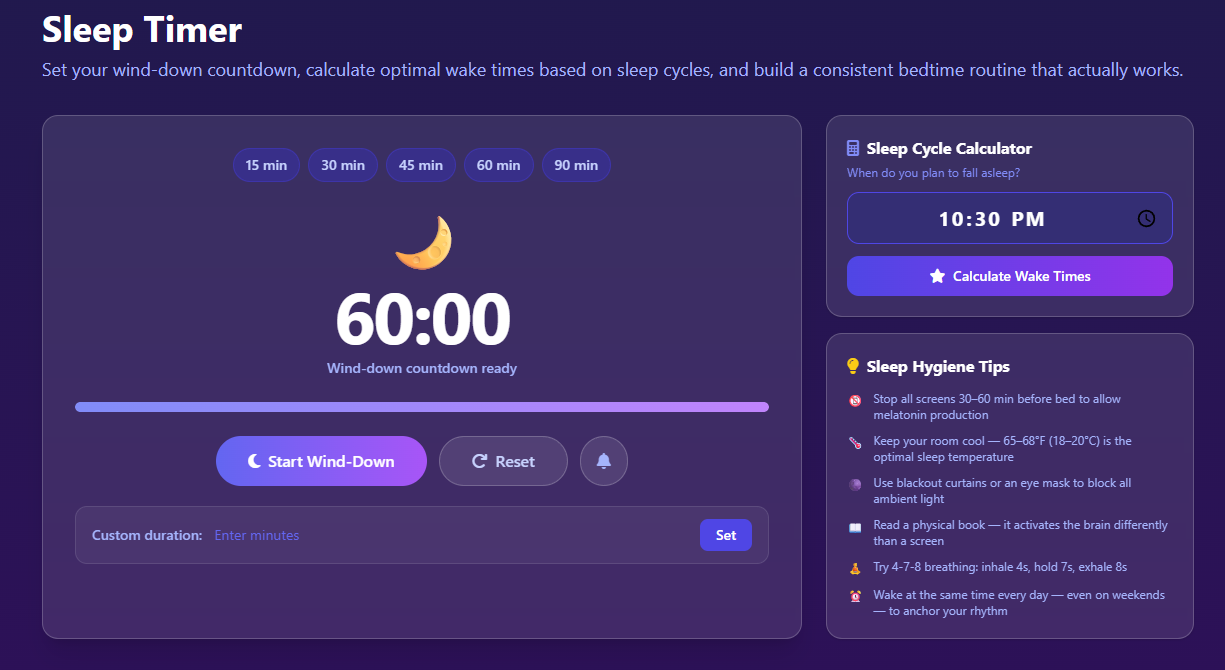
When you set a 60-minute wind-down countdown, you're making a concrete commitment: in one hour, devices go off, the lights dim, and sleep begins. That specificity is what makes it work. Vague intentions like "I'll sleep soon" leave too much room for "just one more episode" or "one more scroll." A running countdown creates urgency and closure that mental notes alone cannot.
The Science of Sleep Cycles and Why Timing Your Wake-Up Matters
Sleep is not a uniform state — it moves through four distinct stages in roughly 90-minute cycles. The first half of the night is dominated by slow-wave deep sleep, which is critical for physical recovery, immune function, and growth hormone release. The second half tilts toward REM sleep, where emotional processing, memory consolidation, and creative thinking happen.
The most important insight from sleep science is this: when you wake up matters as much as how long you sleep. Waking up in the middle of Stage 3 deep sleep causes sleep inertia — that disorienting, groggy feeling that can last for 30 minutes or more. Waking at the end of a complete 90-minute cycle, when you're naturally in lighter sleep, leaves you feeling alert and clear-headed even if the total hours are similar.
The Sleep Cycle Calculator in this tool adds approximately 14 minutes to your chosen sleep time (the average time it takes to fall asleep) and then calculates wake times at 3, 4, 5, and 6 complete cycle intervals. These are your "sweet spots" — the natural valleys between cycles where waking up feels most natural.
Building a Wind-Down Routine That Actually Works
Sleep researchers consistently find that consistent pre-sleep routines shorten sleep onset time and improve sleep quality. The reason is biological: your brain is a pattern-recognition machine. When you repeat the same sequence of activities — dim the lights, make herbal tea, read for 20 minutes, do some gentle stretching — your nervous system learns to associate those cues with sleep onset and begins producing melatonin earlier in the sequence.
Start your sleep timer 45–60 minutes before your target bedtime. Use that window deliberately: avoid screens, do your hygiene routine, perhaps journal briefly about tomorrow's priorities to clear the mental queue, and read something calm. By the time the gentle chime sounds, your body will already be primed for sleep. Pair this with our Countdown Clock Timer for general time management, or the 30 Minute Timer for a shorter wind-down session.