Why You Need a Reading Timer to Build a Real Reading Habit
Reading is one of the highest-return habits you can build. It builds vocabulary, deepens subject knowledge, improves empathy through fiction, reduces cortisol, and is one of the few leisure activities consistently associated with higher life satisfaction in long-term psychological studies. Yet most people who want to read more consistently fail to do so — not because they lack motivation, but because they lack structure. A reading timer addresses the single biggest barrier to consistent reading: knowing when to start and when to stop.
Without a timer, reading sessions suffer from two failure modes. The first is under-reading: you sit down with good intentions but check your phone after two minutes, get distracted, and never find your flow. The second is over-reading: you intended to read for 20 minutes but look up an hour later, behind on your other tasks and feeling guilty. A reading timer solves both problems by setting a clear boundary for your session — a dedicated, protected block of time that belongs entirely to your book.
Count Up Mode: Track Every Minute You Read
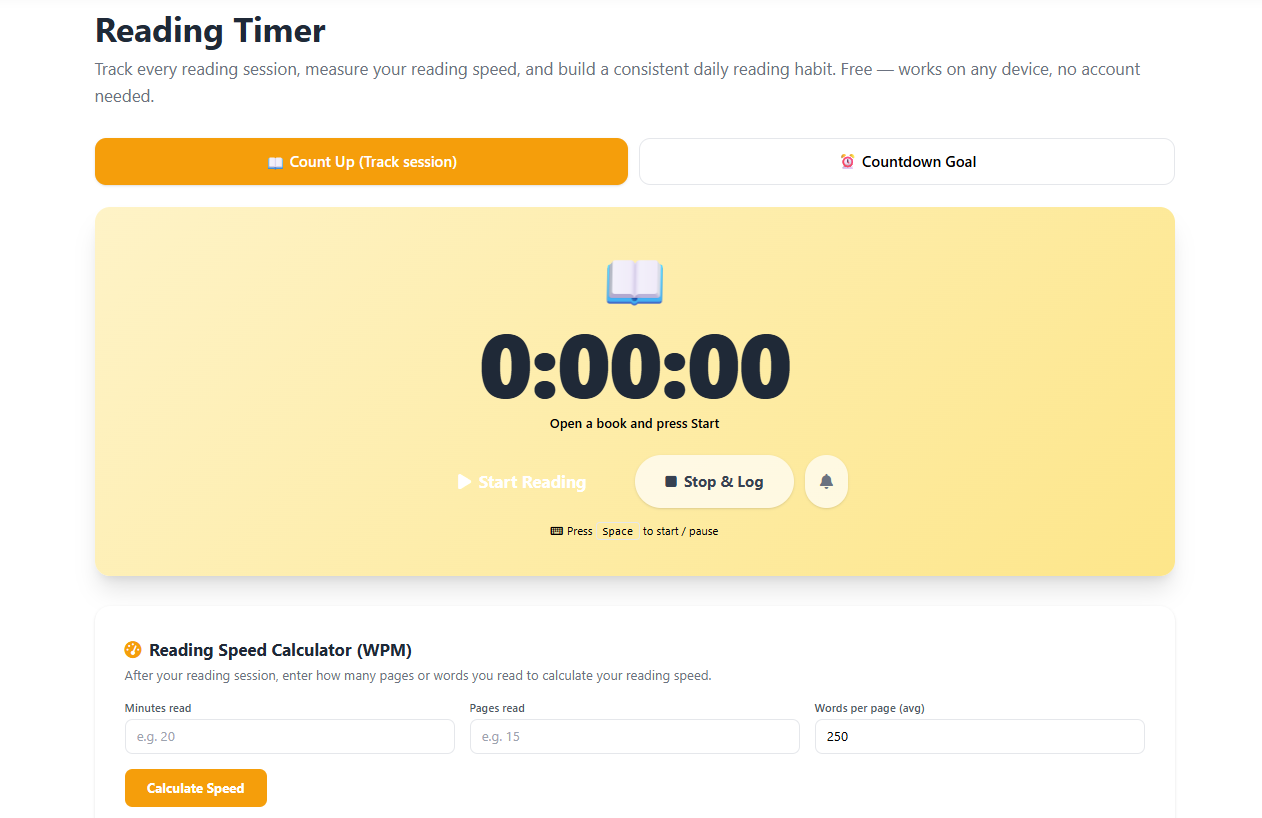
Count-up mode is the most natural way to use a reading timer. Press Start when you open your book, press Pause if you are interrupted, and press Stop when you finish. The elapsed time is logged automatically so you can see exactly how much reading you have accumulated today. Over days and weeks, this reading log becomes powerful motivation — you can see streaks forming, track your progress toward a weekly reading goal, and feel the satisfaction of a concrete number attached to a habit that otherwise feels invisible.
Research on habit formation consistently shows that tracking a behavior increases the frequency of that behavior — a phenomenon called the Hawthorne effect combined with implementation intention theory. Simply measuring your reading time makes you more likely to read. Our session log stores your reading blocks for the current day, shows you a total, and gives you a baseline to improve on tomorrow.
Countdown Goal Mode: Commit to a Fixed Reading Window
Countdown mode flips the dynamic: you commit to a fixed reading duration before you begin. Set 20 minutes, press Start, and the timer holds you accountable until the alarm fires. This approach is especially effective for people who struggle with the "I'll just read until I feel like stopping" mindset, which almost always results in stopping too early. With a countdown goal, stopping early requires consciously overriding the timer — a much harder psychological action than simply drifting away from an open-ended session.
Common reading goal presets on our timer include 15 minutes (the minimum recommended for habit formation), 20 minutes (the sweet spot for busy schedules), 30 minutes (a single reading session for moderate readers), and 45 or 60 minutes for more ambitious sessions. Many reading coaches recommend starting with a 20-minute goal if you are new to structured reading, and increasing by 5 minutes per week as the habit solidifies.
How to Measure and Improve Your Reading Speed
Your reading speed — measured in words per minute (WPM) — is one of the most useful personal metrics a reader can know. It tells you how long any given book will take to finish, helps you set realistic reading goals, and gives you a baseline to improve against if you practice speed reading techniques. The average adult reads non-fiction at around 200 to 250 WPM. Literary fiction, which tends toward more complex syntax, averages 250 to 300 WPM. Technical or academic texts drop to 150 to 200 WPM due to the need for careful comprehension.
Our built-in WPM calculator works by dividing the number of words you read by the number of minutes it took. To use it: read for a timed session, count the pages you covered, enter the page count and your session time, and the calculator estimates your reading speed. Most print books average 250 to 300 words per page, but this varies widely — dense academic texts can run 400 words per page, while illustrated books or large-print editions may have 150 words per page. You can adjust the words-per-page figure in the calculator to match your specific book for a more accurate result.
How Many Books Can You Read Per Year With 20 Minutes a Day?
At 20 minutes of reading per day and an average pace of 250 WPM, you will read approximately 5,000 words per day. A typical non-fiction book contains 60,000 to 80,000 words, meaning you would finish a book every 12 to 16 days. That adds up to 23 to 30 books per year — compared to the national average of fewer than five books per year for most adults. The difference between a reader and a non-reader is not raw ability or intelligence — it is just 20 consistent minutes per day, measured and protected by a simple timer.
Pairing Your Reading Timer With Other Productivity Tools
Many readers combine a reading timer with a focused-work timer to build a full deep-work routine. Use our Pomodoro Timer for work sessions, then switch to the reading timer for learning blocks. For study-focused reading, our Study Timer pairs well with textbook reading sessions. After a long study or reading marathon, the Break Timer ensures you take proper recovery time before the next session. For late-night reading before bed, pair your session with the Sleep Timer to wind down without accidentally reading until midnight.