The Complete Guide to Plank Training and Core Strength
The plank is one of the most deceptively simple yet scientifically powerful exercises in all of fitness. It requires no equipment beyond the floor beneath you, no complex movement patterns to learn, and no gym membership to access. Yet when performed consistently with proper form and progressive duration, it produces measurable improvements in core strength, postural alignment, back pain reduction, and full-body stability that rival far more complicated training protocols. A dedicated plank timer is the single most effective tool for making this simple exercise a consistent, progressive part of your daily routine.
Why a Dedicated Plank Timer Changes Everything
Without a timer, most people significantly underestimate how long they are actually holding their plank. When you are under isometric tension with your entire body trembling, 20 seconds can feel like 2 minutes and vice versa. A dedicated plank workout timer removes all guesswork, holding you accountable to your target duration through every second of every set. When the timer signals that you have reached your goal, you know with certainty that you completed what you set out to do. This psychological precision builds discipline and makes progressive overload — the foundation of all fitness improvement — measurable and trackable.
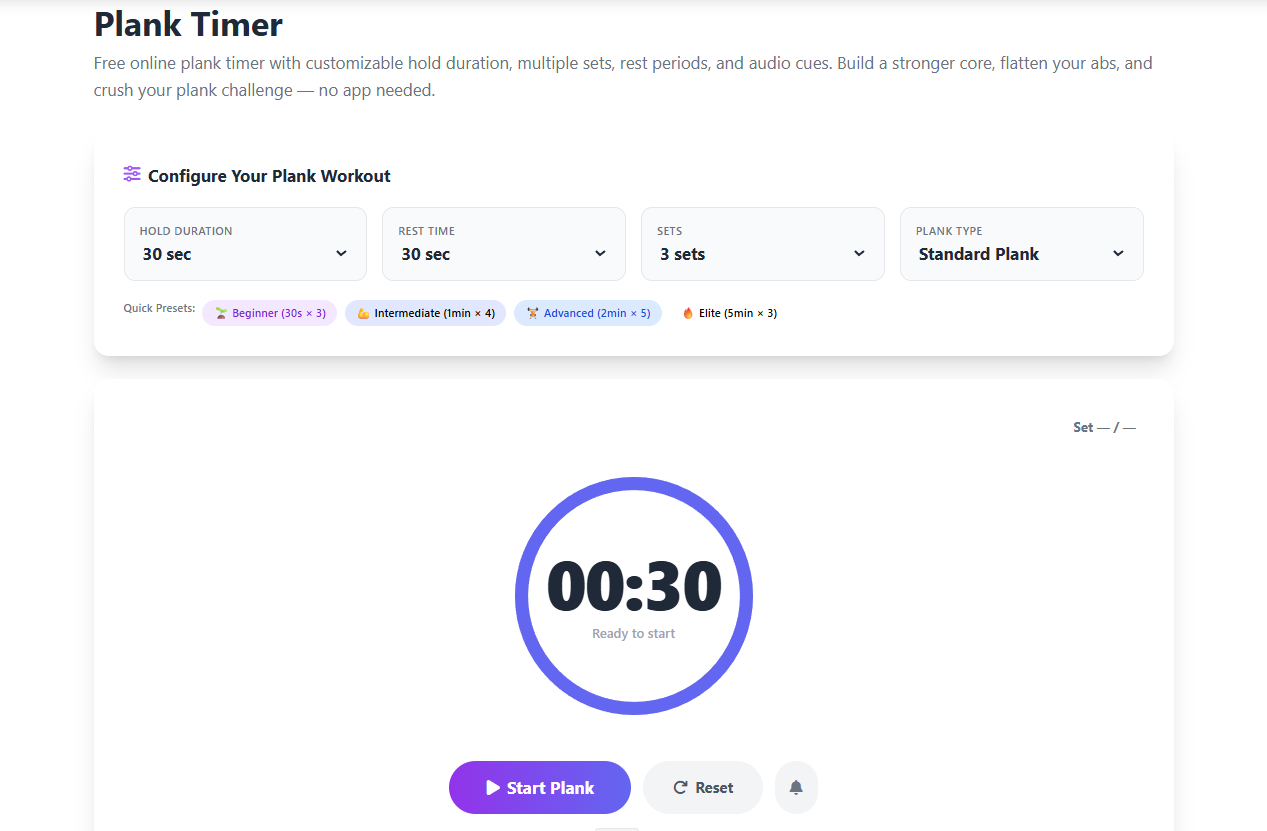
Our free plank timer goes beyond a simple countdown. It supports multiple sets with structured rest periods, letting you complete a full plank circuit with a single configuration. Set your hold duration from 20 seconds to 5 minutes, choose between 1 and 5 sets, and configure rest periods from 15 to 90 seconds. The timer guides you through each set and rest period automatically, with audio cues signaling transitions so you can keep your eyes on your form instead of watching the screen. The session stats panel tracks your total hold time, completed sets, and longest single set, giving you a clear record of your progress over time.
The Muscles a Plank Actually Works
Despite its appearance as a simple static hold, the plank recruits an impressive breadth of muscle groups simultaneously. The primary target is the transverse abdominis — the deepest layer of abdominal muscle that forms a natural corset around your spine. This is the muscle most responsible for spinal stability and the one most neglected by traditional crunches and sit-ups, which target the more superficial rectus abdominis. The plank also heavily engages the obliques on both sides, the erector spinae muscles that run along the spine, the gluteus maximus and medius, the hip flexors, and the shoulder stabilizers including the serratus anterior and rotator cuff muscles.
The forearm plank variation shifts the emphasis more directly onto the deep core stabilizers and reduces wrist strain, making it ideal for those with wrist sensitivity or those focusing specifically on abdominal development. The side plank isolates the obliques and hip abductors with particular effectiveness and is one of the best exercises for developing lateral core strength and reducing the risk of lateral spinal injuries. Incorporating all three variations into your training with this plank timer — standard, forearm, and side — creates comprehensive core development that protects against injury and enhances performance in every athletic activity.
How to Run a 30-Day Plank Challenge
The 30-day plank challenge is one of the most popular structured fitness protocols in home workout culture, and for good reason — it provides a clear progression framework, a specific endpoint to work toward, and daily accountability that keeps motivation high through the full month. Our plank timer is perfectly suited to running a 30-day challenge at any level. In Week 1, set your timer to 30 seconds with 3 sets and 30 seconds of rest. In Week 2, increase hold time to 45 seconds. Week 3 progresses to 60 seconds. Week 4 targets 90 seconds per set. By Day 30, aim for a single 2-minute plank hold — a benchmark that demonstrates genuine core strength development.
The key to success in any plank challenge is consistent form over impressive numbers. Dropping your hips, raising your posterior, or holding your breath to squeeze out extra seconds negates most of the benefit and increases injury risk. Use the timer's audio cue to let you know when you have reached your target duration, then rest completely — set a proper rest timer and do not cheat recovery. If you need extra motivation for your overall training routine, our Workout Timer is designed for full strength and conditioning circuits, and our Boxing Timer adds intense cardiovascular conditioning to complement your core work.
Plank Form: The Foundation of Effective Core Training
Perfect plank form is non-negotiable for both effectiveness and injury prevention. In the standard high plank position, your hands should be directly below your shoulders with arms fully extended, forming a straight line from your head through your heels. Your spine should be neutral — neither rounded upward nor arched downward. Your glutes should be actively squeezed, your core braced as if you are about to absorb a punch to the stomach, and your head aligned with your spine with your gaze toward the floor a few inches ahead of your hands. Your feet should be hip-width apart or closer together for greater challenge.
Common form breakdowns to watch for include the hips sagging toward the floor (a sign of core fatigue — end the set early rather than continuing with degraded form), the hips rising too high (reducing core activation and shifting load to the shoulders), the head dropping below spine neutral (neck strain risk), and the breath being held (counter-productive — breathe steadily and deliberately throughout the hold). If you are using this timer for yoga-based core work or meditation-focused training sessions, pair it with our Yoga Timer for seamlessly timed practice flows.
Plank Training for Back Pain Relief and Posture Improvement
One of the most clinically documented benefits of consistent plank training is its effectiveness for chronic lower back pain reduction. The mechanism is straightforward: the deep stabilizer muscles of the core — particularly the transverse abdominis and multifidus — provide the dynamic support structure that protects the lumbar spine during movement and static posture. When these muscles are weak or inactive due to sedentary lifestyles, the passive structures (spinal discs, ligaments, and facet joints) bear disproportionate load, leading to the chronic pain experienced by millions of desk workers, drivers, and people with prolonged sitting habits.
Research published in clinical physical therapy and sports medicine literature consistently demonstrates that core stability training including planks produces significant reductions in chronic lower back pain intensity, disability scores, and pain medication usage. The plank is particularly valued in rehabilitation contexts because it trains core stability through anti-extension — resisting spinal extension forces — which is the primary functional demand placed on the core during everyday activities, athletic performance, and heavy lifting. For structured study or work sessions where good posture matters, our Study Timer helps you take regular posture and movement breaks throughout long work periods.
Progressive Plank Training: Building to Extraordinary Holds
The world record plank hold stands at over 9 hours — testament to what years of progressive training can achieve. For most people, reaching a 2-minute plank with solid form is an impressive and highly practical goal that signals genuine core strength. Reaching 5 minutes puts you in the top tier of recreational fitness. Getting there requires nothing more than the progressive overload principle — consistently adding small amounts of time to your hold duration, week by week, while maintaining perfect form throughout. Use our plank timer's duration selector to set challenging but achievable targets, track your session stats to celebrate your progress, and trust the process. The timer handles the timekeeping — your only job is to stay straight and breathe. For recovery and flexibility between plank sessions, complement your training with the Sleep Timer to ensure you get the rest your core needs to grow stronger.