The Science of Boiling Eggs Perfectly
The difference between a perfectly cooked egg and a rubbery, green-rimmed disappointment is almost entirely a question of time. Egg white proteins (primarily ovalbumin) begin to denature at around 60°C (140°F) and fully set by 85°C (185°F). Egg yolk proteins set at slightly higher temperatures, between 70°C (158°F) and 77°C (171°F). This temperature difference is what makes precise timing possible: by controlling exactly how long the egg sits in boiling water, you control which proteins have set and which haven't — which is what distinguishes a runny yolk from a jammy one from a fully hard-boiled result.
The times shown in this egg timer assume the hot-start method: eggs go straight into already-boiling water, not cold water brought to a boil. Hot-start cooking is preferred by professional chefs because it gives consistent, repeatable results. The temperature of the water is fixed at 100°C (212°F) from the start, so the only variable is time. Cold-start cooking introduces two variables — time and the rate at which the water comes to a boil — making it harder to reproduce the same result twice.
Soft Boiled Eggs: The 6-Minute Rule
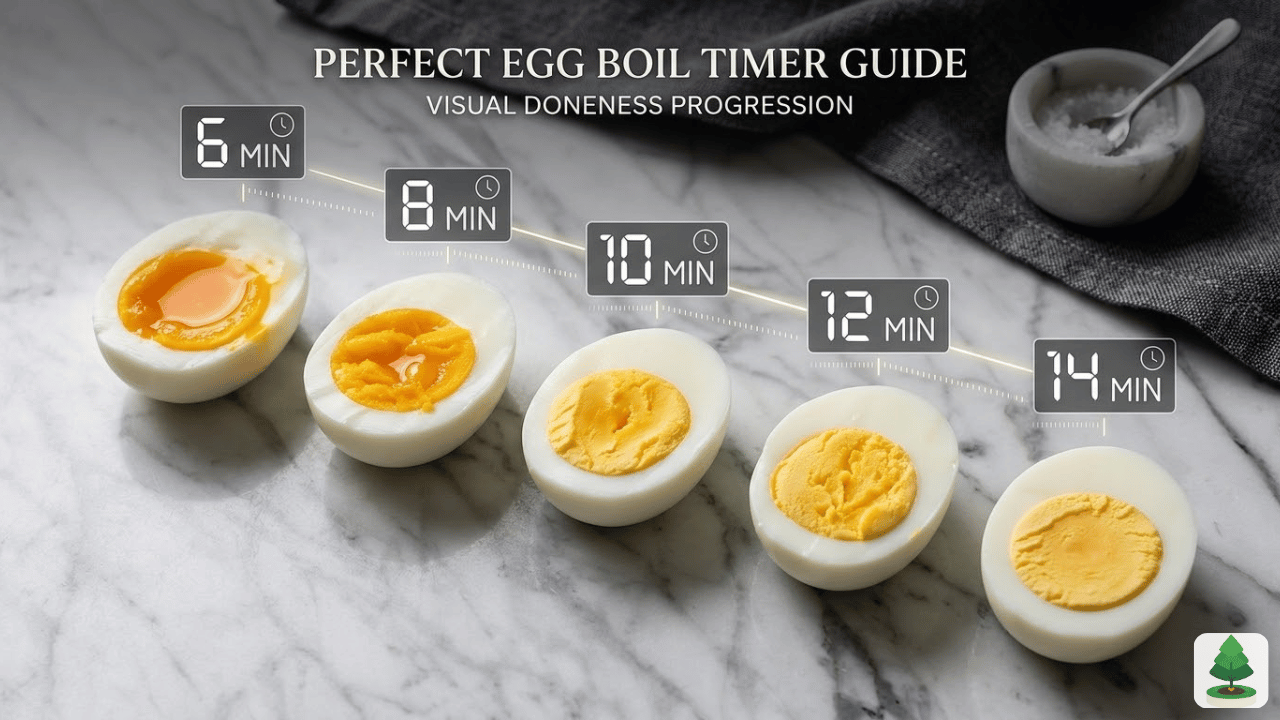
Six minutes in rolling boiling water produces the classic soft-boiled egg: a fully set, tender white and a warm, flowing yolk. This is the standard for soft-boiled eggs served with toast soldiers, a beloved British breakfast tradition. At 7 minutes, the yolk begins to thicken at the edges while remaining liquid in the center — still pourable but more stable. At 5 minutes, you get a barely-set white with an almost entirely liquid yolk: perfect for dipping.
The Jammy Egg: 9 Minutes for Ramen Perfection
The "jammy egg" — popularized by ramen culture and the grain bowl movement — hits its ideal consistency at exactly 9 minutes. The white is firm, the yolk is fully cooked at the surface but creamy and richly orange in the center, with the texture of slightly firm jam. This is the egg that food photographers love: when cut in half, it holds its shape while still revealing a velvety, deep-colored interior. The jammy egg is also ideal for Niçoise salads, avocado toast, and Korean bibimbap. Pair your egg timer with our Kitchen Timer for full meal coordination.
Hard Boiled Eggs and the Ice Bath Rule
At 12 minutes, the yolk is fully set and opaque — ideal for egg salad, deviled eggs, and sliced eggs on sandwiches. The critical step after hard boiling is the ice bath: immediately transferring eggs to ice-cold water stops the cooking process in seconds. Without an ice bath, residual heat continues cooking the yolk for 2–3 more minutes, which is what produces the grey-green sulfide ring around the yolk — a purely cosmetic but widely disliked outcome. For other precise cooking countdowns, explore our Kitchen Timer with recipe presets, or the 5 Minute Timer for quick kitchen tasks.