The Complete CrossFit Timer: AMRAP, EMOM, Tabata & For Time Explained
CrossFit and functional fitness training rely on specific workout formats that each require a different timing approach. Understanding these formats — and having the right timer for each — is fundamental to training correctly, recording accurate scores, and progressing systematically. Our free CrossFit WOD timer supports all four primary workout formats from a single page, with no app download, no subscription, and no configuration required beyond your round and time settings.
AMRAP: As Many Rounds As Possible
AMRAP workouts are among the most common formats in CrossFit programming. You are given a time cap — typically 10, 15, or 20 minutes — and a sequence of movements to cycle through as many times as possible within that window. Your score is the total number of complete rounds plus any additional reps you completed in an unfinished round, written as "rounds + reps" (e.g., 7+12). The AMRAP format tests your ability to sustain a high pace under fatigue, making pacing strategy crucial. Going out too fast burns you out in the first half; going too conservative leaves time on the clock.
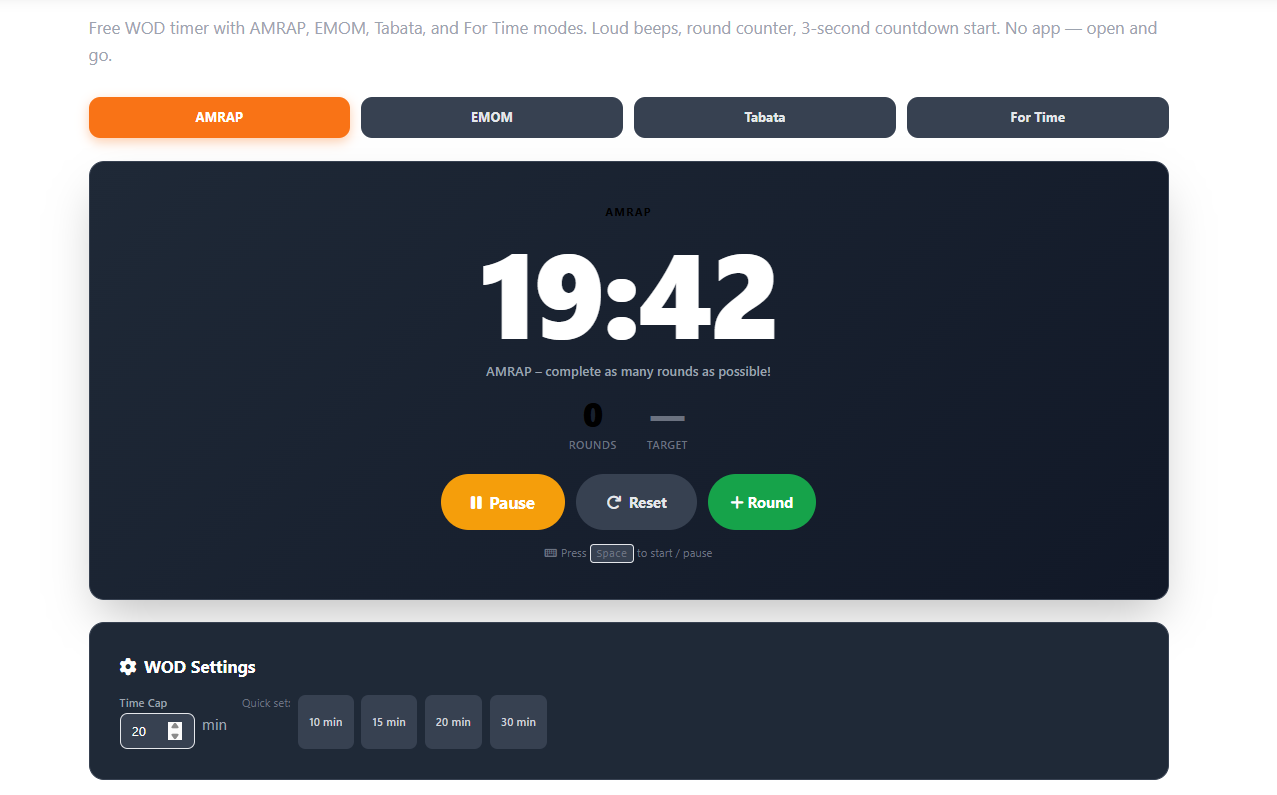
Classic AMRAP benchmark workouts include Cindy (5 pull-ups, 10 push-ups, 15 air squats for 20 minutes), Mary (5 handstand push-ups, 10 pistols, 15 pull-ups for 20 minutes), and countless programming variations. Our AMRAP timer counts down from your time cap with a large, clearly visible display and fires a loud alarm at zero. The manual round counter button lets you track completed rounds without taking your eyes off your movement.
EMOM: Every Minute On the Minute
EMOM workouts structure rest around the clock itself. Every time the clock hits the top of a new minute, you begin the prescribed movement. You work until you finish your reps, and whatever time remains in that minute is your built-in rest. As you fatigue, your rest period naturally shrinks — creating a powerful built-in intensity mechanism. If you cannot complete the reps before the next minute starts, you have exceeded your capacity for that load and need to scale the weight or rep count.
EMOM workouts are highly versatile. They can be used for strength work (1 heavy snatch every minute for 10 minutes), skill practice (5 perfect pull-ups every minute), or conditioning (15 calories on the rower every minute). The EMOM timer format also supports E2MOM (every 2 minutes) and longer intervals — simply set the interval duration in seconds. Our EMOM timer beeps distinctly at each new interval and displays the current round number prominently.
Tabata: The Science-Backed Interval Protocol
Tabata training comes from a landmark 1996 study by Japanese researcher Dr. Izumi Tabata, which found that high-intensity interval training at the specific 20-second work / 10-second rest ratio produced greater cardiovascular and anaerobic adaptations in six weeks than an hour of steady-state aerobic exercise. The classic Tabata protocol is 8 rounds of 20-second maximum-effort work and 10-second rest, totaling exactly 4 minutes. It is one of the most time-efficient conditioning protocols in existence.
Our Tabata timer mode automatically alternates between work and rest phases, playing a high-pitched beep at the start of each work phase and a lower tone at the rest transition. The round counter tracks your progress through all 8 rounds. You can customize round count, work duration, and rest duration if you want to use a modified Tabata protocol — for instance, 6 rounds with 30-second work and 15-second rest for a different intensity curve.
For Time: Racing the Clock
For Time workouts are deceptively simple: complete the prescribed workout as fast as you possibly can. Your score is the finishing time. Famous benchmark For Time workouts include Fran (21-15-9 thrusters and pull-ups), Grace (30 clean-and-jerks at 135/95 lbs), and Diane (21-15-9 deadlifts and handstand push-ups). The competitive drive of racing your own previous time — called a PR, or personal record — is one of the most powerful motivators in all of fitness.
Our For Time timer counts up from zero so you always know your elapsed time. You can optionally set a time cap — if you hit the cap without finishing, your score is recorded as "cap + reps." Press the Stop button when you finish to record your time. For athletes who want to see both their elapsed time and a comparison to their last performance, keep a training log alongside the timer. Our WOD Clock offers additional display options for gym settings.
Why a Good CrossFit Timer Matters
Functional fitness training at any level demands precise time management. Inaccurate timing produces inaccurate scores, making it impossible to track real progress. A timer that is difficult to read from across a room disrupts your workout while you squint at a screen. A timer that does not beep loudly enough is useless in a noisy gym environment. Our CrossFit timer is designed with all of these practical constraints in mind: the display is large and high-contrast, the audio beeps are generated at a volume calibrated for workout environments, and the interface requires minimal interaction so you can get back to your barbell.
For a general interval timer that works for other training styles including boxing rounds, HIIT, yoga intervals, and circuit training, see our Tabata Timer and Exercise Timer. For gym owners or coaches managing multiple athletes, the timer works equally well on a tablet mounted on a wall or connected to a TV via screen mirroring.