Why Taking Breaks Makes You More Productive, Not Less
The instinct to push through without stopping feels productive, but decades of cognitive science research tell a different story. The human brain is not designed for continuous, uninterrupted focus. Sustained attention without rest leads to a well-documented phenomenon called attention fatigue — a gradual decline in the quality and speed of cognitive processing that no amount of willpower can reverse in the short term. The only reliable cure is a genuine mental break away from the task at hand.
Studies from the University of Illinois found that brief diversions from a task can dramatically improve ability to focus on that task for prolonged periods. Researchers at Baylor University showed that employees who fully detached during lunch breaks reported higher levels of energy and focus in the afternoon. The MIT Media Lab found that workers who took structured micro-breaks produced higher-quality creative work than those who worked without interruption. The evidence is consistent across disciplines: strategic rest is not a reward for finishing work — it is a tool for doing better work.
How a Break Timer Enforces the Rest You Keep Skipping
The problem is not that people do not know breaks are beneficial — it is that without an external signal, breaks get postponed indefinitely. "I'll finish this paragraph first" becomes "I'll just finish this section" becomes "I'll take a break after this email" until the workday is over and no break was ever taken. A break timer removes that internal negotiation entirely. When the alarm goes off, the break is mandatory, not optional.
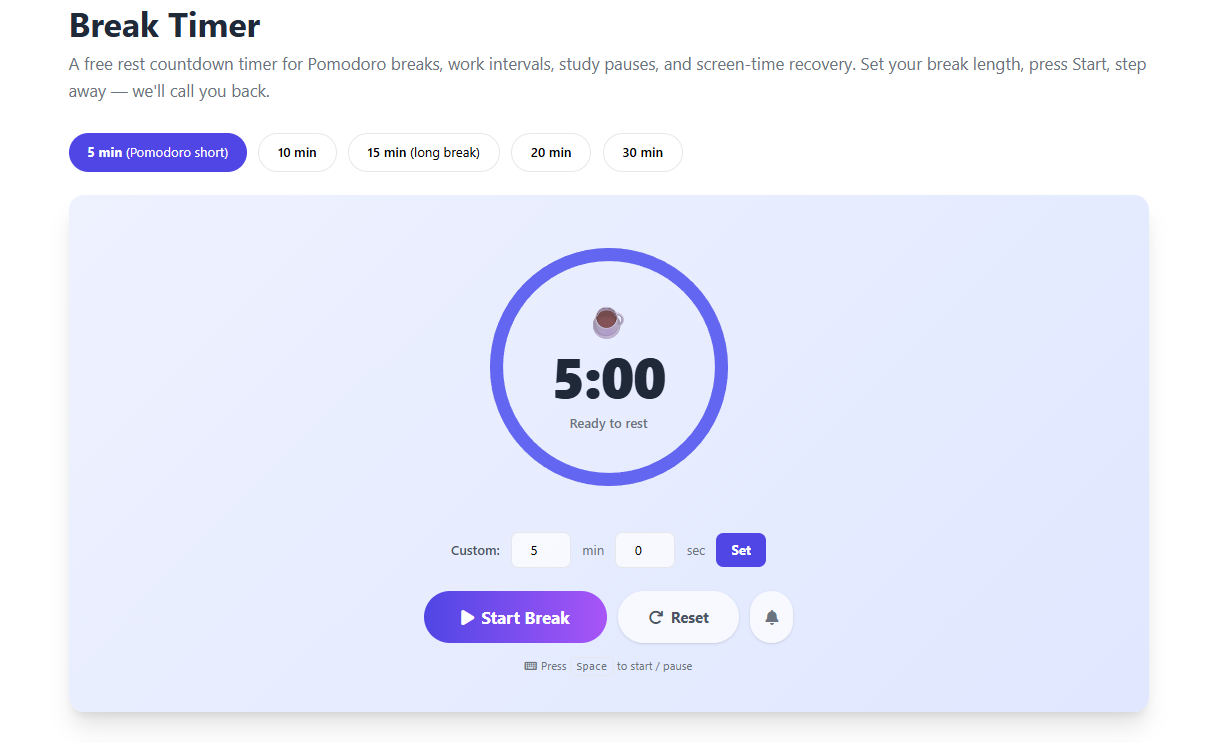
Our free break timer gives you a visual countdown ring and an audible alarm to mark the end of your rest period. You can choose from one-click presets for the most common break lengths — 5 minutes for a Pomodoro short break, 10 minutes for a mid-morning pause, 15 minutes for the recommended long Pomodoro break, or 20 and 30 minutes for extended recovery. You can also set any custom duration to the exact second, making it ideal for highly structured schedules and time-blocking routines.
The Science of the Optimal Break Length
Research on optimal work-to-break ratios suggests that a 52-minute work period followed by a 17-minute break produces the highest sustained productivity across a full workday — a finding from a large-scale analysis by the Draugiem Group. The Pomodoro Technique, which specifies 25 minutes of work followed by a 5-minute break (with a longer break every four cycles), is the most widely adopted structured approach and has decades of practitioner-reported success behind it. For cognitively demanding tasks like writing, programming, or academic study, longer work sessions of 45 to 90 minutes with 10 to 20 minute breaks tend to align better with natural ultradian rhythms in human alertness and energy.
There is no universally optimal break length because individuals differ significantly in their sustained attention capacity, their task type, the time of day, and their overall fatigue level. The best approach is to experiment. Start with the 5-minute Pomodoro preset if you are new to structured breaks. If that feels too short and interrupts your flow at a bad moment, try a 25-to-10-minute ratio. If you are deep in creative or analytical work, a 90-to-20-minute rhythm might serve you better. Our Pomodoro Timer automates this full cycle, including both the work and the rest countdown, if you prefer a fully managed session.
What Science Says About the Best Break Activities
Not all breaks are created equal. Research distinguishes between restorative breaks that genuinely replenish cognitive resources and pseudo-breaks that keep the brain in an activated, depleted state. The single most important rule for a restorative break is to step away from screens. Checking social media, reading news, or switching to email during a break keeps your prefrontal cortex engaged in information processing and prevents the neural recovery that makes breaks beneficial in the first place.
Physical movement is the most well-evidenced break activity for cognitive recovery. Even a five-minute walk — particularly in a natural setting — has been shown to reduce mental fatigue, improve working memory, and boost creative thinking. If you cannot go outside, stand up, stretch your neck and shoulders, walk to a different room, or do a short yoga flow. Hydration is equally important and often overlooked: mild dehydration of as little as one to two percent body weight impairs cognitive performance measurably, particularly short-term memory and concentration.
Pairing Your Break Timer With Other Focus Tools
The break timer works best as one part of a structured productivity system. Before your break, use a focus tool like our Study Timer or Pomodoro Timer to manage the work period. After your break, use our 5 Minute Timer for a brief warm-up task before returning to deep work. For end-of-day wind-down, the Sleep Timer helps you transition from work mode to rest mode with intention. Together these tools create a complete daily rhythm of focused work, strategic recovery, and intentional rest.