The Complete Guide to Boxing Timer Training
Whether you are working the heavy bag solo, drilling combinations with a partner, or running timed sparring sessions at your gym, a reliable boxing timer is one of the most essential pieces of equipment in any combat athlete's toolkit. A purpose-built round timer does far more than count down minutes — it creates the structured, rhythmic cadence that replicates the exact pacing of a real fight. When the bell rings to start a round and rings again to end it, your body begins to internalize the tempo of competition, building the physical conditioning and mental fortitude that separate trained fighters from casual practitioners.
How a Boxing Round Timer Structures Your Training
The standard boxing format — three minutes of work followed by one minute of rest — is not arbitrary. It mirrors the exact structure used in professional boxing bouts from amateur Golden Gloves competitions all the way up to world title fights sanctioned by the WBC, IBF, WBA, and WBO. This specific work-to-rest ratio is engineered to push fighters into the upper ranges of both anaerobic and aerobic energy production, training the cardiovascular system to sustain explosive output over the full duration of a fight. When you use a boxing interval timer that enforces these intervals consistently, your body adapts to the rhythm over weeks and months, developing the precise conditioning needed to perform in the late rounds when the fight is often won or lost.
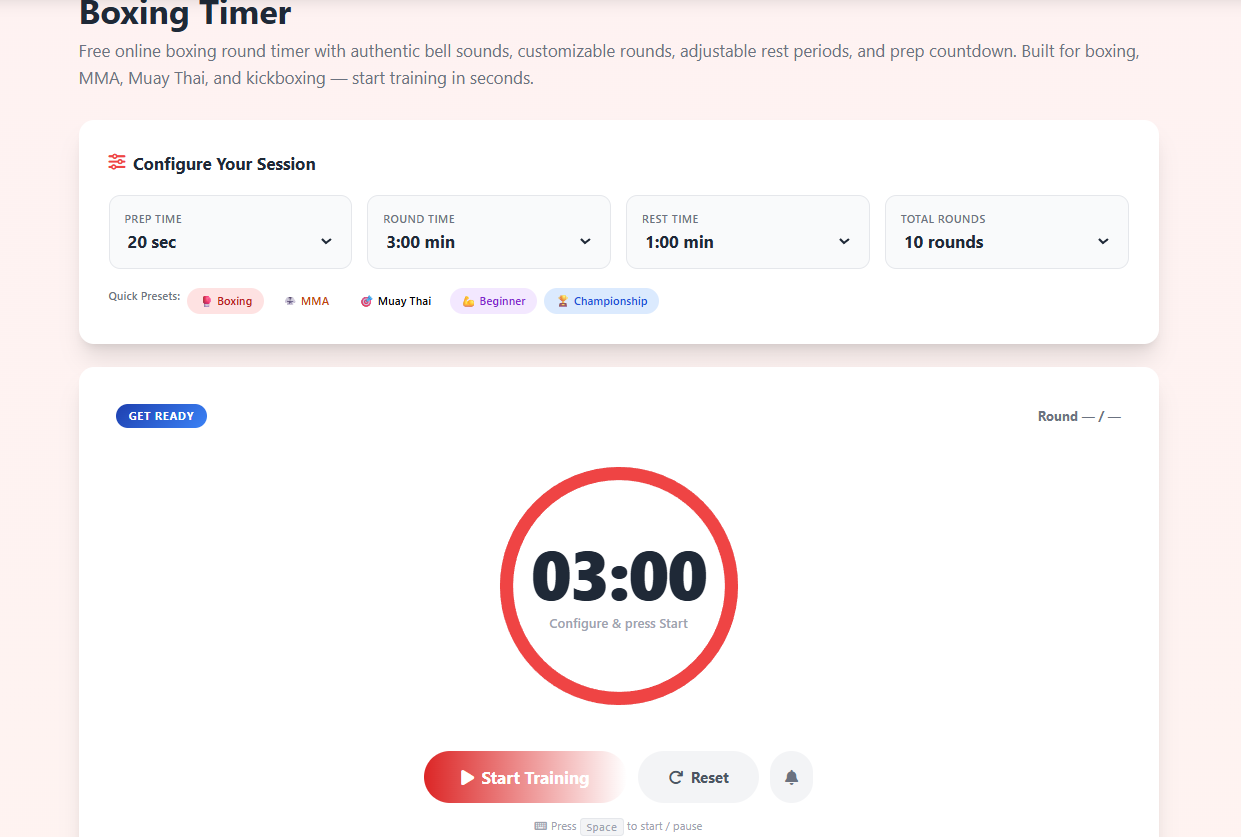
Our free online boxing timer gives you complete control over every variable that matters. Set round duration from 90 seconds to 5 minutes, rest periods from 30 seconds to 2 minutes, and total round count from 3 to 15. The prep countdown — 20 seconds by default — gives you time to tighten your wraps, adjust your gloves, take your stance, and mentally commit to the session before Round 1 begins. This small detail is often missing from generic interval timers, and it makes a meaningful difference in the authenticity and effectiveness of your training.
Sport Presets for Boxing, MMA, Muay Thai, and Kickboxing
Different combat sports use different round formats, and our boxing round timer is designed to handle all of them without requiring manual configuration every time you train. The Boxing preset uses the classic 3-minute round and 1-minute rest format used in professional and amateur competition worldwide. The MMA preset extends rounds to 5 minutes to match the formats used by UFC, Bellator, PFL, and ONE Championship. The Muay Thai preset uses 3-minute rounds with 2-minute rest, reflecting traditional Thai stadium timing as used at Lumpinee and Rajadamnern. The Beginner preset uses shorter 2-minute rounds and generous rest periods, making the timer accessible for people new to combat sports training or high-intensity interval work. The Championship preset runs 12 rounds — the full distance of a professional title fight — for fighters in serious fight camp preparation.
Heavy Bag Training and the Round Timer
Heavy bag work is where most fighters develop their offensive foundation, and a boxing bag timer transforms that solo drilling from casual punching into structured, fight-specific conditioning. When the bell rings to start a round, your mindset shifts immediately from warm-up mode to competition mode. You move your feet, you vary your combinations between head and body, and you pace your output the way you would in an actual bout. The timer creates accountability — you cannot step back and rest until the bell rings, exactly as in a real fight. This mental and physical discipline, practiced consistently over weeks and months, is what builds the late-round toughness that wins fights.
Structure each heavy bag round around specific technical goals rather than simply throwing punches for the full duration. Use early rounds for technical work — jab-cross-hook combinations, footwork patterns, and defensive movement. Mid-session rounds are ideal for body attack sequences, uppercut combinations, and pressure fighting. Final rounds should push your output to maximum intensity, replicating the urgency and desperation of the championship rounds in a fight. The one-minute rest between rounds gives you just enough time to sip water, lower your heart rate, and mentally prepare for the next round.
Using a Boxing Interval Timer for HIIT and Fitness Classes
The boxing timer format is not exclusive to fighters. The high-intensity interval structure it enforces is one of the most effective training protocols in sports science for cardiovascular fitness, fat burning, and metabolic conditioning. Kickboxing fitness classes, CrossFit facilities, and personal training sessions around the world use round timers because the bell creates shared urgency and group accountability. Our timer's clear display and crisp bell sounds work equally well in a quiet home gym and a loud commercial training facility. For complementary interval training, pair this with our Tabata Timer for the classic 20-on, 10-off protocol, or with our Workout Timer for general strength and conditioning circuits.
Training Like a Professional Fighter
Professional boxers train two sessions daily, five to six days per week, with round volume peaking at 10 to 15 rounds per session during fight camp. While most people training with a boxing round timer are not preparing for professional bouts, adopting the professional mindset toward structure elevates every single session. Commit to your rounds completely. Do not step off the bag until the bell rings. Do not extend your rest beyond the allotted time. These disciplines compound over time into real improvements in cardiovascular capacity, punching endurance, and mental toughness under pressure. The timer is not just a clock — it is a training partner that holds you accountable to the standard you want to achieve.
The Science of Round-Based Interval Training
Exercise physiology research consistently demonstrates that structured interval training — alternating high-intensity work periods with timed recovery — produces superior adaptations in both aerobic capacity and anaerobic power compared to steady-state cardio performed for the same total duration. The 3-minute round format sits in the optimal zone between pure sprint-interval training and aerobic threshold work, training both energy systems simultaneously. A 10-round boxing session delivers approximately 30 minutes of high-intensity work with 9 minutes of structured recovery — a training stimulus that builds fight-specific conditioning, coordination, and mental resilience that no treadmill or elliptical can replicate. For core and bodyweight conditioning between boxing sessions, try our Plank Timer. To track your overall fitness progress, the Stopwatch Timer is always available for timed drills and conditioning tests.