Why 25 Minutes Is the Perfect Focus Interval
The 25-minute timer has become the most widely recognized productivity interval in the world, largely due to the Pomodoro Technique developed by Francesco Cirillo in the late 1980s. As a university student struggling with distraction, Cirillo used a tomato-shaped kitchen timer — "pomodoro" is Italian for tomato — set to 25 minutes to impose strict, distraction-free working periods on himself. The results were dramatic enough that he formalized the approach, and it has since become a cornerstone of modern productivity methodology.
Why 25 specifically? Cognitive science offers several explanations. First, sustained attention degrades sharply after 20–30 minutes without an external structure. The 25-minute interval is long enough to enter a focused flow state (which typically requires 10–15 minutes to initiate) and work within it productively, but short enough that the brain doesn't experience the fatigue and attention drift that longer sessions inevitably produce. Second, the short, predictable duration makes the technique psychologically accessible — almost anyone can commit to focusing for just 25 minutes, even on a bad day.
How to Run an Effective 25-Minute Focus Session
Before starting the timer, define exactly what you're working on. Write it down or type it — anything from "draft introduction for report" to "review 20 flashcards for biology exam." This pre-session intention-setting is often skipped but consistently shown to double the productivity of each interval. Vague sessions produce vague results.
Once the timer starts, treat interruptions as non-negotiable violations of the session. If something comes to mind, jot it on a notepad and return to it after the 25 minutes end. Your phone should be face-down or in another room. Every Pomodoro that you complete without interruption trains your brain's ability to maintain focused attention — like building a muscle through reps.
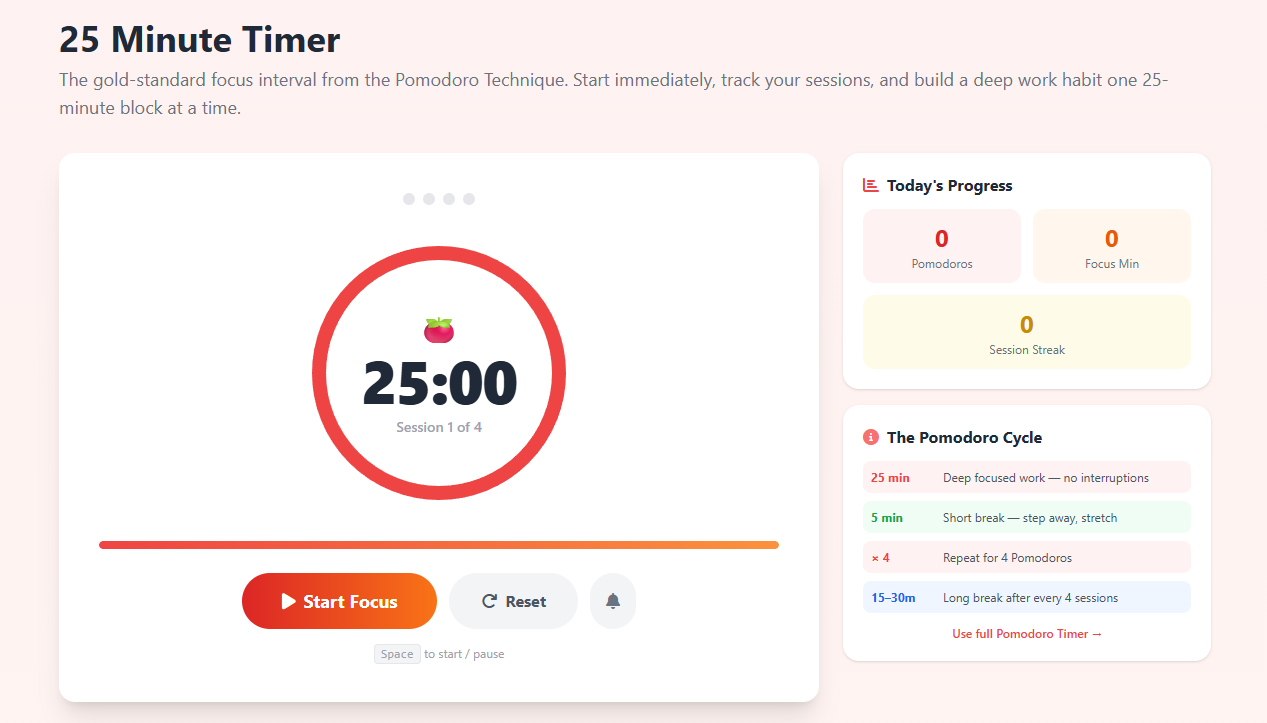
After the timer rings, mark the session complete (the dots above the timer track your progress through each set of four) and take a genuine 5-minute break. Stand up, look out a window, do some light movement. After four sessions, take a 15-to-30-minute long break before the next set.
25 Minutes vs. Other Focus Intervals
The 25-minute interval is the standard Pomodoro, but it is not the only valid focus duration. The 15-minute timer works better for simple tasks, reviewing material, or when focus is fragile. The 30-minute timer suits meetings and activities that naturally fit a half-hour block. The 52-minute method (from DeskTime research) and the 90-minute ultradian rhythm are better for complex deep work. Start with 25 minutes and adjust based on your task type and natural rhythm. For full Pomodoro cycle management with break scheduling, use our dedicated Pomodoro Timer or the Tomato Timer.