25:00
Time to focus!
Session 1 of 4 · Long break after completing all 4
🌳
Today: 0 pomodoros completed
Time to focus!
Session 1 of 4 · Long break after completing all 4
The Overview
Whether you are a student pulling a late-night study session, a remote worker drowning in distractions, or someone with ADHD trying to build a consistent work rhythm, a Pomodoro timer is one of the simplest — and most proven — tools you can add to your daily routine. Our free Pomodoro timer online at Forest Focus Timer is designed to help you start working in short, powerful bursts so that every minute counts.
In this complete guide, you will learn exactly what a Pomodoro timer is, how the Pomodoro Technique works, why 25 minutes is the sweet spot for deep focus, how it helps people with ADHD, and how to use our free focus timer to get the most out of every work session.
The Technique
The Pomodoro Technique is a time management method developed by Francesco Cirillo in the late 1980s. Named after a tomato-shaped kitchen timer, it breaks work into focused 25-minute intervals separated by short breaks — dramatically improving concentration and reducing mental fatigue.
Our free online Pomodoro timer adds a unique twist: your virtual forest grows with every completed focus session, giving you a beautiful, visual reward for your hard work.
A Pomodoro timer is a countdown timer specifically designed to support the Pomodoro Technique, a time-management method developed by Francesco Cirillo in the late 1980s. The word "Pomodoro" is Italian for tomato — a nod to the tomato-shaped kitchen timer Cirillo used as a university student when he first developed the system.
The basic idea is elegantly simple: you set a timer for 25 minutes, work with complete focus until it goes off, then take a 5-minute break. That 25-minute block is called one Pomodoro. After completing four Pomodoros, you reward yourself with a longer break of 15 to 30 minutes., You can customize it accordingly.
A Pomodoro clock — whether it is a physical device, a dedicated app, or a free online timer — acts as your focus partner. It makes a clear, audible commitment to the task at hand and signals your brain that it is time to shift into deep work mode. Unlike a generic countdown timer, a true Pomodoro timer tracks your sessions, manages your break timer automatically, and helps you build a measurable productivity record over time.
The tomato timer nickname comes directly from the origin story. Francesco Cirillo used a tomato-shaped kitchen timer — a pomodoro — during his study sessions at university. That iconic image stuck, and today tomato timer and "Pomodoro timer" are used interchangeably. If you have ever searched for a tomato timer or a Pomodoro clock, you are looking for exactly the same thing.
This is one of the most common questions people ask, and it is a great one. The 25-minute default was not chosen at random. Cirillo arrived at this duration through personal trial and error, and decades of research in cognitive psychology have since backed it up.
Here are the key reasons the 25-minute focus window works so well:
It fits within your attention span. Research consistently shows that sustained focused attention begins to degrade after roughly 20 to 30 minutes. The 25-minute Pomodoro catches you right before mental fatigue sets in, keeping your output at its highest quality throughout the session.
It creates urgency without panic. Twenty-five minutes is short enough to feel manageable — even when you are facing a task you have been avoiding — but long enough to make meaningful progress. That tight window activates what psychologists call the Yerkes-Dodson curve: a moderate level of time pressure that sharpens performance without tipping into anxiety.
It forces you to commit. When you start a 25-minute work timer, you are making a micro-contract with yourself: no email, no social media, no interruptions for just 25 minutes. That low-stakes commitment is far easier to keep than an open-ended "I'll work until I'm done" promise.
It builds natural rhythms. Over time, your brain learns to anticipate the cycle of focus and rest. Like interval training for your concentration, repeating Pomodoros trains you to move into deep focus faster and sustain it longer than if you worked in unstructured stretches.
That said, the 25-minute default is not a law. Many people customize their focus timer based on their task type, energy level, or neurodivergent needs. Some prefer 50-minute deep work sessions with 10-minute breaks. Others thrive with shorter 15-minute Pomodoros. Our free Pomodoro timer online lets you adjust both your work sessions and your break timer to match exactly how your mind works best.
The Steps
The original Pomodoro Technique is a structured five-step process. Here is how to follow it using our free focus timer:
Choose Your Task — Before you start the timer, write down exactly what you will work on. Specificity matters. "Work on project" is vague; "Write the introduction paragraph of the quarterly report" is actionable. Clear tasks produce cleaner focus.
Set Your Pomodoro Timer to 25 Minutes — Click start on our free Pomodoro timer online and commit fully to your chosen task. No multitasking. If a distraction or random thought pops up, jot it down quickly on a notepad and return immediately to your work. You can deal with it during the break.
Work Until the Timer Rings — Give the task your complete, undivided attention until the Pomodoro alarm sounds. Do not stop early, and do not overrun. The boundary is the point.
Take a 5-Minute Short Break — Step away from the screen. Stretch, breathe, grab water, or stare out the window. This short break is not idle time — it is when your brain consolidates what you just worked on, a process neuroscientists call memory consolidation during rest.
After Every 4 Pomodoros, Take a Long Break — Once you have completed four consecutive 25-minute work sessions, reward yourself with a 15 to 30-minute long break. Go for a short walk, have a meal, or simply decompress. This resets your mental energy for another round of deep focus.
Our Pomodoro app at Forest Focus Timer handles all of this automatically. It moves seamlessly from your work timer to your break timer, tracks how many Pomodoros you have completed, and alerts you at the start and end of each phase — so you can focus entirely on the work instead of watching the clock.
The ADHD Pomodoro Technique
Yes — and research and lived experience both strongly support this. The Pomodoro Technique has become one of the most recommended self-management tools for people with ADHD, and for very good reasons.
ADHD (Attention-Deficit/Hyperactivity Disorder) is characterized by difficulty sustaining attention on non-stimulating tasks, a poor internal sense of time, impulsivity, and vulnerability to distraction. The Pomodoro system directly addresses each of these challenges:
External time structure. People with ADHD often struggle with "time blindness" — an inability to accurately perceive how much time is passing. A running Pomodoro timer makes time visible and concrete, acting as an external scaffold that the ADHD brain cannot generate internally.
Built-in permission to stop. One of the most paralyzing ADHD experiences is the feeling that starting a task means you are committed to doing it indefinitely. Knowing you only need to focus for 25 minutes removes that pressure and makes starting dramatically easier.
Frequent dopamine rewards. ADHD brains are often dopamine-deficient, which makes sustaining effort on tasks that are not immediately rewarding very hard. Completing each Pomodoro provides a small but real sense of accomplishment — a dopamine hit — that keeps the reward loop running.
Structured breaks prevent hyperfocus traps. Paradoxically, some people with ADHD hyperfocus on interesting tasks and forget to eat, rest, or switch tasks. Scheduled break timers interrupt that cycle and protect overall wellbeing and balance.
Reduced decision fatigue. The system tells you exactly what to do next, removing the constant re-decision about whether to keep working or take a break — a process that drains cognitive resources people with ADHD can barely spare.
Many ADHD coaches, therapists, and productivity researchers recommend starting with a shorter work interval — sometimes as brief as 10 or 15 minutes — and gradually building up toward the full 25-minute Pomodoro as your focus stamina grows. Our free Pomodoro timer online supports fully custom durations so you can dial in exactly what works for your brain.
Why should you use
There are dozens of Pomodoro apps and online timers available, so why choose Forest Focus Timer? Here is what sets our free Pomodoro timer apart:
Our Pomodoro timer online launches the moment you open your browser. There is nothing to install, no account to create, and no personal data to hand over. Click start and you are already in your first focus session.
Our core Pomodoro timer is 100% free. You get full access to the 25-minute work timer, the 5-minute short break timer, and the 15-minute long break timer at no cost. Productivity tools should not sit behind a paywall.
Need a 50-minute deep work session? Prefer a 20-minute focus block? Working with a child who can only concentrate for 10 minutes? You can set your own work and break durations to build a productivity timer that fits your life, not a generic template.
We built our Pomodoro clock with one goal in mind: keep you focused. The interface is minimal, calming, and free of the ads and notifications that plague many competing apps. When you open Forest Focus Timer, the only thing demanding your attention is your work.
Whether you are a student using it as a study timer between classes, a developer using it as a work timer during sprint sessions, or a writer using it to hit daily word counts, Forest Focus Timer adapts to whatever goal sits in front of you.
Many people skip breaks because they feel guilty for stopping. Our break timer is designed to make rest feel intentional and deserved — because it is. Taking breaks is not a weakness in the Pomodoro system; it is the mechanism that makes sustained focus possible.
Benefits of Pomodoro Timer
The Pomodoro Technique is one of the few productivity systems that genuinely works across very different types of people and work styles. Here is a look at who uses it and why it helps:
Cramming for exams by sitting at a desk for five straight hours is one of the least effective ways to retain information. Studying in 25-minute focused blocks with strategic breaks has been shown to improve both retention and recall. Use our study timer to break your revision into manageable Pomodoros, and you will absorb more material in two hours of structured study than in six hours of passive reading.
Home environments are full of productivity traps: the refrigerator, the television, the dog, the never-ending scroll of social media. Our work timer gives remote workers a structured rhythm that recreates the focused "in the zone" feeling of an office environment — without the commute.
Creative blocks are often just resistance to starting. Committing to a single 25-minute Pomodoro removes the pressure of "I need to write something brilliant" and replaces it with "I just need to write for 25 minutes." Most writers find that once they are past the starting friction, the work flows far more naturally than they expected.
Deep coding work requires long stretches of uninterrupted focus. The Pomodoro Technique helps programmers batch their context-switching — email and Slack replies happen during breaks, not during the Pomodoro — protecting the mental state needed to hold complex logic in working memory.
As covered above, the external structure, manageable time blocks, and predictable rhythm of the Pomodoro system make it a particularly effective tool for anyone whose brain needs more scaffolding than standard open-ended work sessions provide.
How to Use
Getting started with Forest Focus Timer takes less than 60 seconds. Here is exactly what to do:
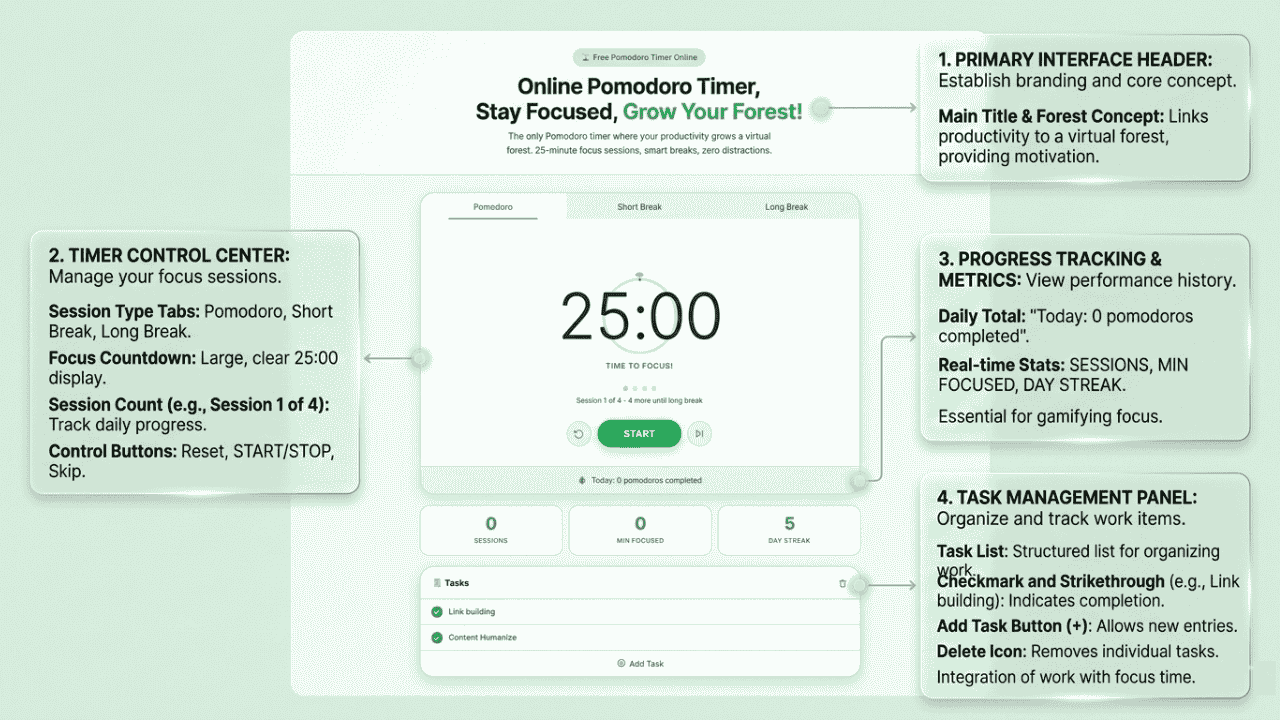
Open your browser and go to pomodoro timer by forest focus.
Decide on your first task. Write it down on a notepad or in your task manager.
Set your work session duration. The default is 25 minutes, but you can customize it.
Click Start and begin working on your task — and only your task — until the timer sounds.
When the alarm goes off, click the break timer and take a genuine 5-minute rest.
After four Pomodoros, take your long break of 15 to 30 minutes before the next round.
Pro tip: If you are interrupted during a Pomodoro — a phone call, a question from a colleague, an urgent email — you have two choices. If the interruption can wait, defer it and mark a tick next to your task list item. If it genuinely cannot wait, void the Pomodoro (it does not count), handle the interruption, and restart a fresh 25-minute session. Tracking interruptions over time reveals patterns that help you protect your focus hours.
The Science Behind the Pomodoro Technique
The Pomodoro Technique predates much of the modern neuroscience that now explains why it works so well. Here are the mechanisms behind the method:
Humans operate on ultradian rhythms — biological cycles of roughly 90 to 120 minutes during which the brain alternates between higher and lower states of alertness. Within those larger cycles, peak focused attention tends to occur in windows of 20 to 30 minutes. The Pomodoro's 25-minute session lands squarely inside this natural window.
Psychologist Bluma Zeigarnik discovered in the 1920s that the human mind holds incomplete tasks in a state of open tension, returning to them involuntarily. Starting a Pomodoro — even when a task feels overwhelming — activates this effect, pulling your mind naturally back toward completion.
Sports scientists and learning researchers who study elite performers have found that high-quality focused practice in short, intense bursts produces better results than long unfocused sessions. The Pomodoro method mirrors this deliberate practice structure, applied to knowledge work.
During rest, the brain's default mode network becomes active and processes information gathered during focused work. Short breaks are not wasted time; they are when your brain files, connects, and consolidates what you just learned or created. Skipping breaks actually slows your overall output.
Common Questions
The Pomodoro timer is a time-management tool based on the Pomodoro Technique developed by Francesco Cirillo. It counts down a 25-minute focused work session followed by a short 5-minute break. After four sessions, you take a longer 15 to 30-minute break. The timer helps you work in structured, distraction-free intervals that improve focus, reduce mental fatigue, and build consistent productivity habits.
Francesco Cirillo arrived at 25 minutes through personal experimentation, and cognitive research supports this choice. Human focused attention tends to degrade after 20 to 30 minutes, making 25 minutes the sweet spot that captures peak concentration before mental fatigue sets in. The short duration also feels non-threatening, making it easier to start tasks you would otherwise procrastinate. Many people customize their Pomodoro length to fit their personal focus style.
Yes, the Pomodoro Technique is widely considered one of the best self-management strategies for people with ADHD. The short, defined work intervals address time blindness, reduce the overwhelm of open-ended tasks, provide frequent dopamine rewards through task completion, and use an external timer to supply the structure that ADHD brains struggle to generate internally. Many ADHD coaches recommend starting with 10 to 15-minute Pomodoros and gradually building up to the standard 25 minutes.
The five steps are: (1) Choose the specific task you will work on. (2) Set your Pomodoro timer for 25 minutes. (3) Work with complete focus until the timer rings — no interruptions. (4) Take a genuine 5-minute short break to rest and reset. (5) After completing four Pomodoros, take a long break of 15 to 30 minutes before starting the next round.
Yes. Our core Pomodoro timer online is completely free. You get access to fully customizable work sessions, short break timers, and long break timers at no charge, with no sign-up required. Simply open the page and start your first Pomodoro.
Yes! Research on time-boxing and structured breaks consistently shows the Pomodoro Technique improves focus, reduces cognitive fatigue, and increases daily output. The urgency of a ticking timer fights procrastination while mandatory breaks prevent burnout.
Absolutely. The Pomodoro technique is one of the most popular study methods because it prevents mental fatigue, improves information retention, and makes long study sessions feel manageable. Use our free study timer at Forest Focus Timer to break your study material into 25-minute blocks, and you will absorb more in less time than traditional marathon study sessions.
Most practitioners aim for 8 to 12 Pomodoros per workday, which translates to roughly 4 to 6 hours of focused work. This might sound low, but 8 high-quality, distraction-free Pomodoros typically produce more output than an unfocused 8-hour day. Start with a realistic target — even 4 Pomodoros is a great beginning — and increase gradually as your focus stamina builds.
Join thousands of focused users growing virtual forests every day.
 Add to Chrome - Free
Enjoying Forest Focus Timer? Please leave us a review ⭐