
Meditation Timer

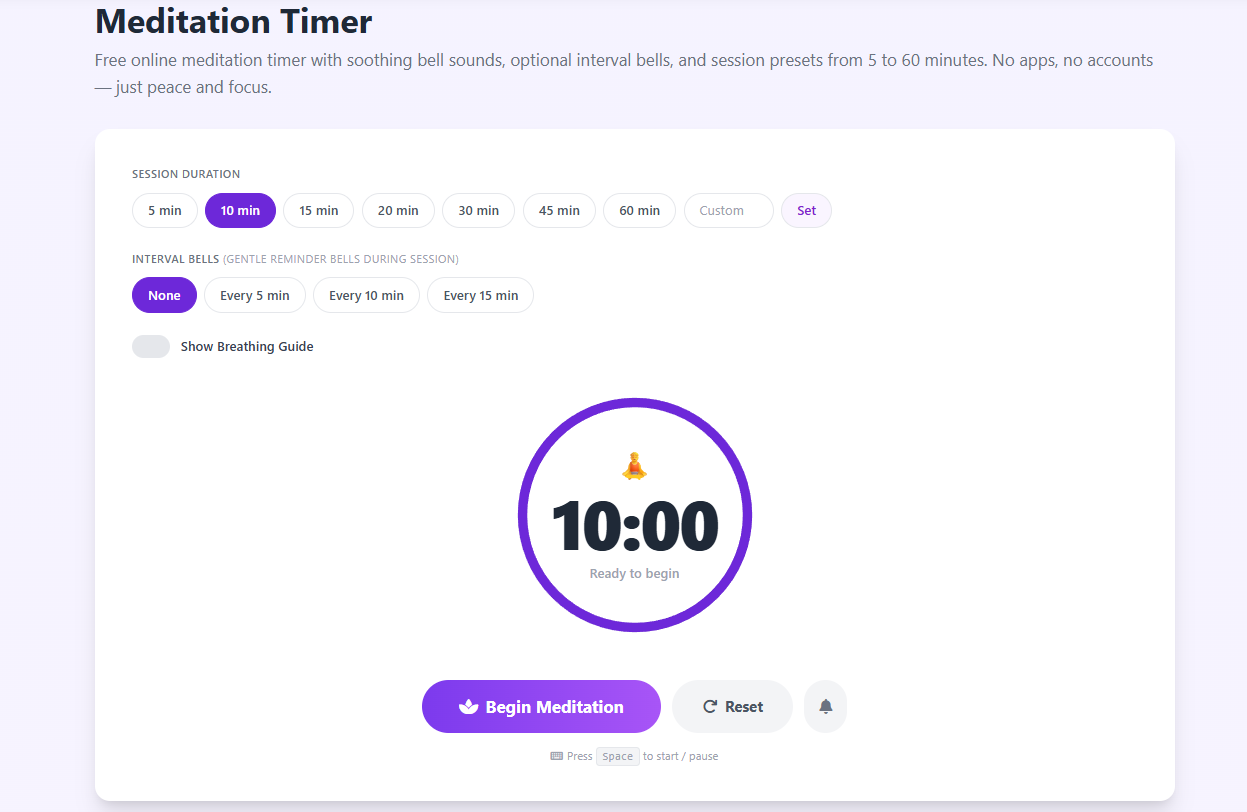
Free online meditation timer with soothing bell sounds, optional interval bells, and session presets from 5 to 60 minutes. No apps, no accounts — just peace and focus.

Session Duration

Interval Bells (gentle reminder bells during session)

🧘
10:00
Ready to begin

Press Space to start / pause

Breathing Techniques to Try During Your Session

🔵
Natural Breath
Simply observe your natural breathing without trying to control it. Notice the sensations. The most accessible technique for beginners.
🌊
Box Breathing
Inhale 4s → hold 4s → exhale 4s → hold 4s. Used by Navy SEALs for stress control. Excellent for anxiety and focus.
🌙
4-7-8 Breath
Inhale 4s → hold 7s → exhale 8s. Activates the parasympathetic nervous system. Ideal for falling asleep or reducing acute stress.
☀️
Equal Breathing
Inhale 4s → exhale 4s. Equal duration creates balance and calm. The simplest breath control practice from pranayama yoga.
Share: Facebook X WhatsApp LinkedIn Reddit

Why Every Meditation Session Needs a Timer — Not a Stopwatch

One of the most common beginner mistakes in meditation is sitting down to practice without setting any kind of time boundary. The result is predictable: you spend the first several minutes wondering how long you've been sitting, open your eyes to check your phone, re-close them, wonder again, and before long the session is more about time anxiety than meditation. A dedicated meditation timer eliminates this entirely. You set the duration, press start, and genuinely release the need to track time — because the bell will tell you when the session is over.

The reason this matters psychologically is that meditation asks you to practice letting go of control — including control over time. A timer is not a crutch. It's the scaffolding that makes the practice possible. You're not avoiding responsibility for your time; you're delegating one specific task (time tracking) so that your full attention is available for the practice itself.

The Research Case for Daily Meditation

The evidence base for mindfulness meditation has grown substantially since Jon Kabat-Zinn's foundational Mindfulness-Based Stress Reduction (MBSR) program in the 1970s. Peer-reviewed studies have consistently found that regular meditation practice reduces cortisol levels (the primary stress hormone), improves emotional regulation by thickening the prefrontal cortex, reduces activity in the default mode network (the brain region associated with mind-wandering and rumination), and improves sleep quality. A landmark meta-analysis published in JAMA Internal Medicine found that mindfulness meditation programs produced moderate improvements in anxiety, depression, and pain outcomes. Perhaps most significantly, these benefits were found at doses as low as 8 minutes per day — well within what most people can realistically commit to.

Pairing Meditation with Physical Recovery

Meditation and high-intensity exercise make excellent complements. After a demanding HIIT workout or Tabata session, a 5–10 minute seated meditation helps bring your nervous system back to a parasympathetic (rest-and-digest) state, accelerating recovery and reducing the lingering stress response. Meditation also pairs naturally with work sessions: try a 10-minute meditation before a deep focus block using our Pomodoro Timer, and notice the difference in your concentration quality when your mental state is settled before you begin.
Meditation Timer

Related Timer Tools

Frequently Asked Questions

How do I use this meditation timer?

Select your session duration (5–60 minutes), choose whether you want interval bells during the session, optionally enable the breathing guide animation, then press Begin Meditation. A bell sounds at the start of your session and again at the end. If you enabled interval bells, a softer bell chimes at each interval to gently mark your progress without disturbing your focus.

How long should I meditate as a beginner?

Start with just 5–10 minutes per day. Research confirms that consistent short sessions build the habit more effectively than occasional long sessions. Most beginners find 10 minutes to be the sweet spot — long enough to settle the mind, short enough not to feel overwhelming. Gradually increase duration as 10 minutes starts to feel comfortable, typically after 2–4 weeks.

What does the breathing guide do?

When enabled, a soft pulsing circle appears behind the timer ring as a visual breathing cue — expanding and contracting on a 4-second cycle. This can help beginners who find it hard to anchor their attention to the breath alone. More experienced practitioners may prefer to turn it off and work with natural breath awareness or a mantra.

Will the end bell disturb me too suddenly?

The end bell is a soft, resonant singing bowl tone — specifically designed not to be jarring. It fades in gently and decays naturally over several seconds, giving you a smooth transition out of your meditation state rather than the harsh shock of a regular alarm. Interval bells are even softer, designed to be noticeable but not disruptive.

Is this meditation timer free?

Yes, completely free. No account, no app download, no subscription. Works in any browser on any device. Start your practice immediately — no setup required.