Why an Interval Timer Is the Most Useful Fitness Tool You're Not Using Correctly
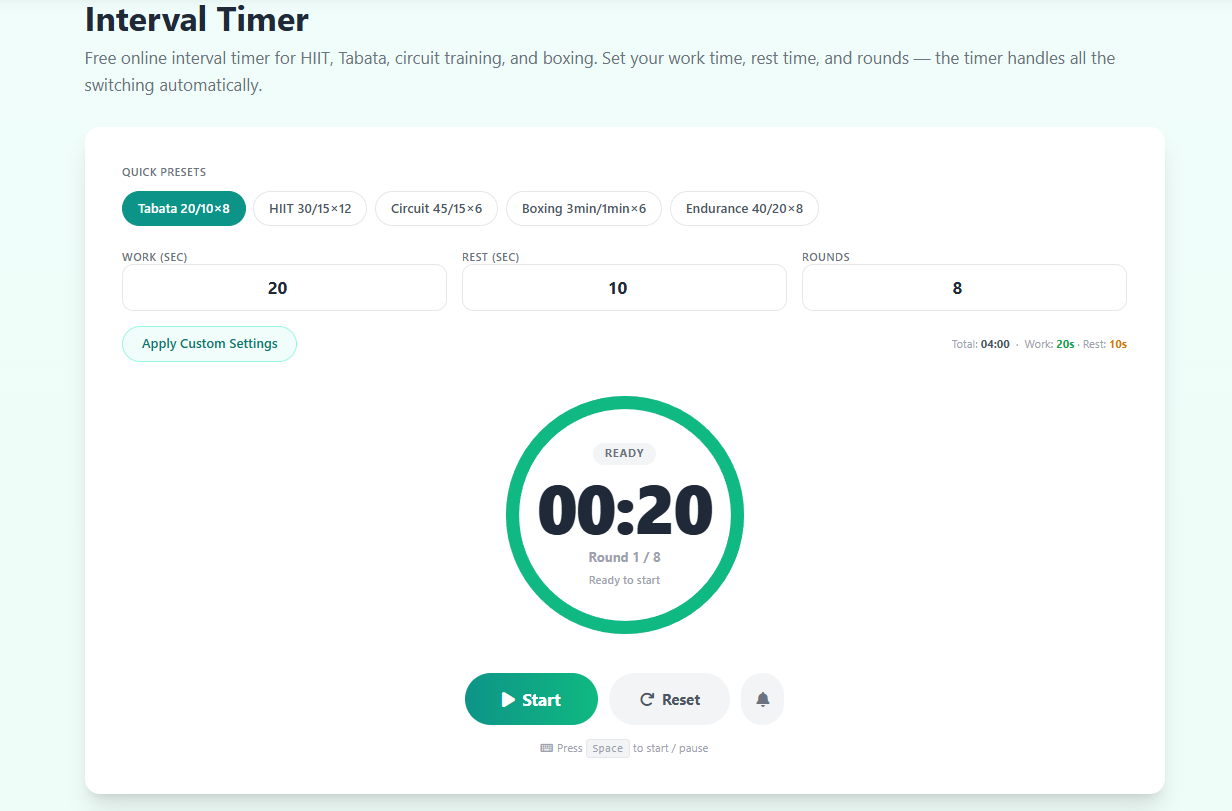
Most people who work out manually restart their stopwatch between every set, glance at their phone constantly, or lose count of rounds entirely. An interval timer solves all three problems at once. You configure your work duration, rest duration, and total rounds once — then the timer automatically switches between phases and tracks your rounds for you. Your entire mental focus goes into the workout itself, not managing the timing.
The science behind interval training is well-established: alternating between high-intensity effort and structured recovery pushes your cardiovascular system harder than steady-state exercise in far less time. A 2:1 work-to-rest ratio — like the 20 seconds on, 10 seconds off structure used in Tabata — keeps your heart rate elevated through the recovery period while still allowing partial recovery. This creates a metabolic demand that continues burning calories for up to 48 hours after the workout ends, a phenomenon known as excess post-exercise oxygen consumption, or EPOC.
Choosing the Right Work-to-Rest Ratio
Your work-to-rest ratio is the single most important variable in interval training. A 1:2 ratio (20 seconds work, 40 seconds rest) is appropriate for beginners or for exercises requiring careful technique — the longer rest allows your body to recover so each work interval can be performed with proper form. A 1:1 ratio (30 seconds each) is standard for intermediate fitness levels. A 2:1 ratio (40 seconds on, 20 seconds off) is advanced territory and produces the greatest metabolic stimulus — but never chase intensity ratios beyond what your fitness level allows. The quality of effort in each work interval matters more than the ratio itself.
Interval Training Beyond the Gym
Interval timers are not just for fitness. The same work/rest structure is used in the Pomodoro productivity technique (25 minutes of focused work, 5 minutes of rest), debate speech timing, music practice sessions, and language learning sprints. For the strict 20/10×8 Tabata protocol, our Tabata Timer runs it automatically with set counting. For a cardiovascular HIIT workout with warm-up and cool-down guidance, try the HIIT Timer. For structured focus sessions with automatic break scheduling, the Pomodoro Timer is your best companion.