
HIIT Timer

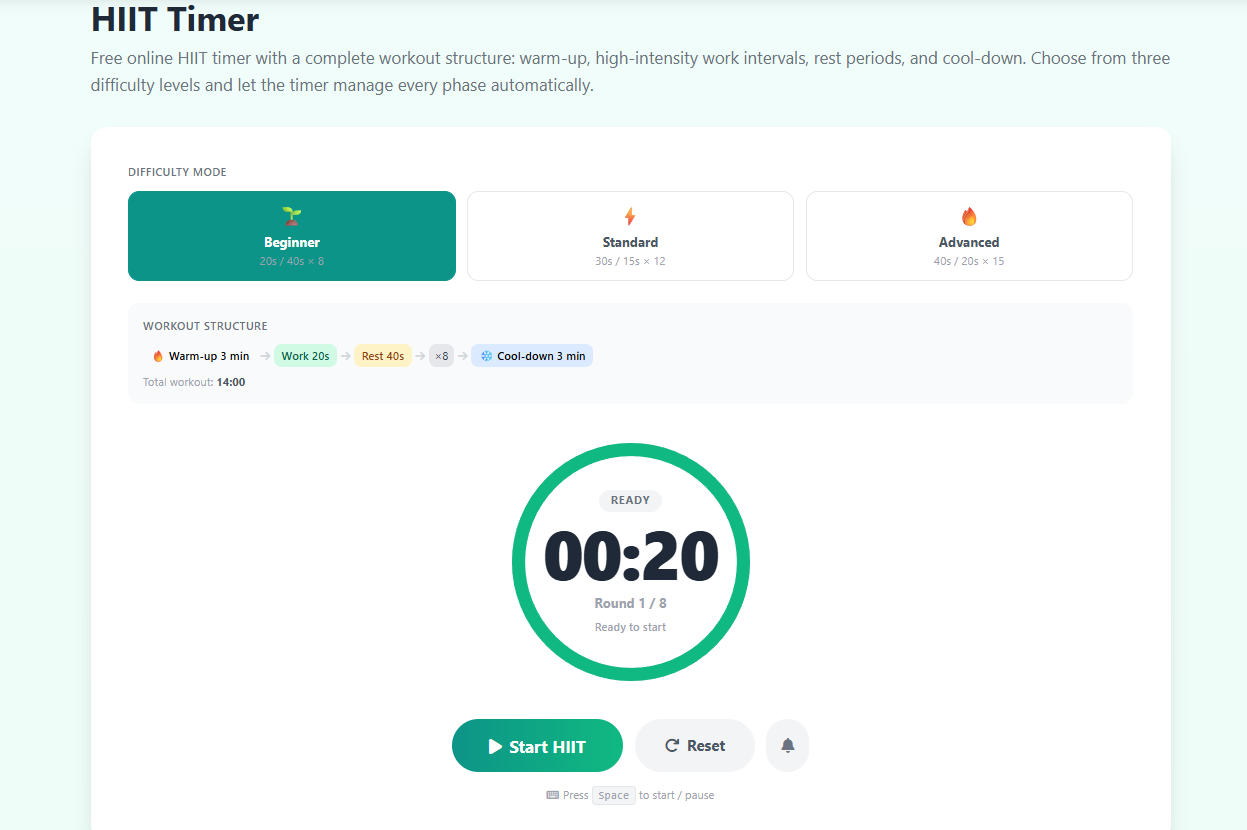
Free online HIIT timer with a complete workout structure: warm-up, high-intensity work intervals, rest periods, and cool-down. Choose from three difficulty levels and let the timer manage every phase automatically.

Difficulty Mode

Workout Structure

🔥 Warm-up 3 min
Work 20s
Rest 40s
×8
❄️ Cool-down 3 min

Total workout: 10:40

Ready
00:20
Round 1 / 8
Ready to start

Press Space to start / pause

HIIT Exercise Ideas by Phase

Structure your HIIT session with appropriate exercises for each workout phase.

🔥Warm-Up (3 min)
  • • Marching in place × 30s
  • • Arm circles × 30s
  • • Leg swings × 30s each side
  • • Slow high knees × 30s
  • • Hip rotations × 30s
  • • Light bodyweight squats × 30s
Work Intervals (max effort)
  • • Burpees — full body, highest burn
  • • Sprint in place — pure cardio
  • • Jump squats — leg power
  • • Mountain climbers — core + cardio
  • • Box jumps — explosive power
  • • Kettlebell swings — posterior chain
❄️Cool-Down (3 min)
  • • Slow walking in place × 60s
  • • Standing quad stretch × 30s each
  • • Hamstring fold × 30s
  • • Child's pose × 30s
  • • Seated spinal twist × 30s each
  • • Deep breathing × 30s
Share: Facebook X WhatsApp LinkedIn Reddit

HIIT Training: Why Less Time Produces Better Results

High-Intensity Interval Training (HIIT) is one of the most thoroughly researched exercise methods in modern sports science. Dozens of peer-reviewed studies have confirmed what practitioners discovered decades ago through trial and error: short, intense bursts of exercise interspersed with brief recovery periods produce cardiovascular and metabolic improvements that far exceed what traditional steady-state cardio delivers, in a fraction of the time. A 25-minute HIIT session, structured properly with warm-up and cool-down, can produce greater aerobic capacity improvements than 60 minutes of moderate jogging.

The physiological reason is rooted in how your body responds to intensity thresholds. Steady-state cardio, performed at a comfortable pace for extended periods, primarily trains your aerobic energy system. HIIT, by cycling between high-intensity bursts and active recovery, simultaneously stresses both your aerobic and anaerobic energy systems. This dual-system stress forces broader cardiovascular and metabolic adaptations, increases your lactate threshold, and triggers significant EPOC — the elevated calorie burn that continues for 12–48 hours after the session ends.

Why Warm-Up and Cool-Down Are Non-Negotiable

Many people skip the warm-up because they're pressed for time and treat the cool-down as optional. Both approaches increase injury risk significantly. The warm-up gradually elevates your heart rate, increases blood flow to working muscles, improves joint mobility, and prepares your neuromuscular system for explosive movement. Going from a resting state directly into maximum-intensity exercise forces your cardiovascular system to rapidly compensate — a stress that can cause muscle strains, joint injuries, and in some individuals, cardiac events. The cool-down serves an equally important role: gradually reducing heart rate, preventing blood from pooling in your lower extremities, and beginning the metabolic recovery process that determines how well you perform in your next session.

How Often Should You Do HIIT?

Most exercise physiologists recommend a maximum of 3 HIIT sessions per week, with at least one full rest day between sessions. HIIT places real stress on your muscles, joints, and cardiovascular system — and adaptation happens during recovery, not during training. If you're also doing strength training, schedule HIIT on alternating days. For a pure Tabata format (the most intense interval protocol), use our Tabata Timer. For fully customizable work/rest/rounds, the Interval Timer gives you maximum flexibility. To decompress and recover between hard sessions, try the Meditation Timer.
HIIT Timer

Related Timer Tools

Frequently Asked Questions

How does this HIIT timer work?

Select your difficulty mode (Beginner, Standard, or Advanced), then press Start. The timer automatically guides you through a 3-minute warm-up, then cycles through your work intervals and rest periods for the selected number of rounds, then finishes with a 3-minute cool-down. Each phase change triggers an audio cue and the ring color changes to indicate your current phase.

Which mode should a beginner choose?

Start with Beginner mode (20s work / 40s rest × 8 rounds). The 1:2 work-to-rest ratio gives your body enough recovery time to maintain good form through all 8 rounds. Spend 2–3 weeks at Beginner before trying Standard. Never start at Advanced if you're new to HIIT — it dramatically increases injury risk.

What is the ring color scheme?

Pink ring = warm-up phase. Green ring = work interval (go hard). Amber ring = rest period (active recovery). Blue ring = cool-down. The badge above the timer also displays the phase name clearly. At the last 3 seconds of each work or rest interval, the ring turns red and a short beep counts you down.

What's the difference between HIIT and Tabata?

Tabata is a specific, fixed HIIT protocol: exactly 20s work / 10s rest × 8 rounds at near-maximum intensity. HIIT is the broader umbrella — any interval training that alternates high-intensity and recovery phases qualifies as HIIT. If you want the strict Tabata protocol, use our Tabata Timer. This HIIT timer offers more flexibility and includes the warm-up and cool-down that most real-world HIIT sessions require.

Is this HIIT timer free?

Yes, completely free. No account, no app download, no subscription. Works in any browser on any device. Start your HIIT workout immediately.